
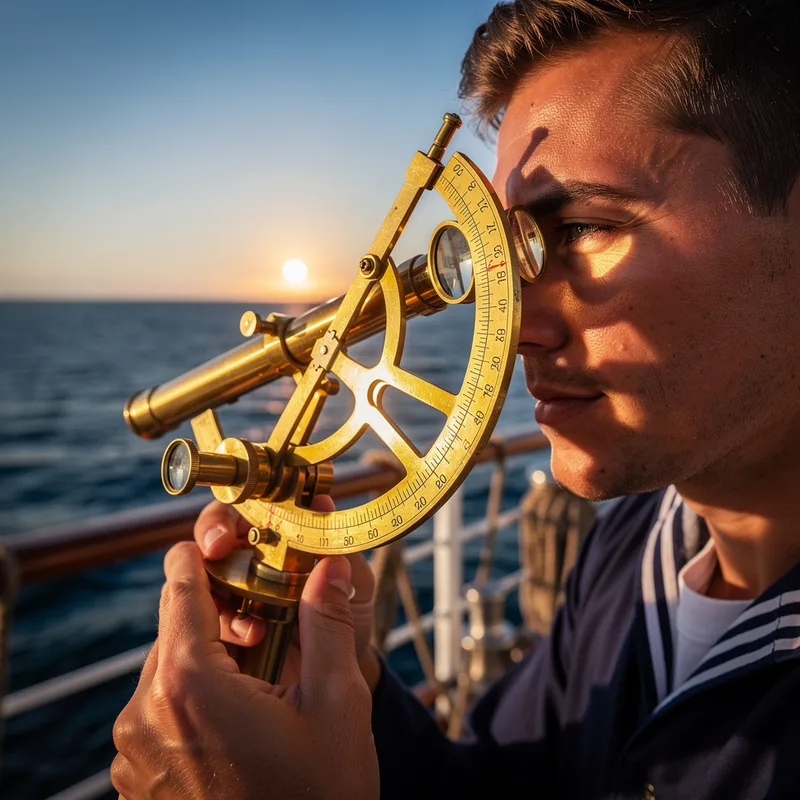
sextant
 4
9.5
4
9.5

- noun
- /ˈsɛkstənt/
- Specialized
- To navigate accurately at sea, sailors often rely on a sextant to measure the angle between the horizon and a star.
- use a sextant
Examples
-
And so by measuring the angle between the horizon and a specific celestial body, like the sun, a sextant can help determine one's latitude.
-
By focusing the sight of the sextant on the North Star, they established their latitude, or distance from the equator.
Academic text (1994) -
So what you would do is measure each point, each star, with a sextant.
-
Now the students were ready to use their sextants.
Academic text (1994) -
Early navigators used a simple instrument called a sextant to determine their latitude.
Academic text (1994) -
To plot an exact position, you need three things: a sextant, an accurate chronometer and a celestial almanac.
-
Picard tears open the box and pulls out a 19th-century sextant—an old-fashioned nautical navigational instrument.
Fiction book (1994) -
Using a sextant, the captain was able to determine their position based on the stars' angles.
-
In the 18th century, sailors used a sextant as a crucial tool for finding their latitude and longitude.
Synonyms
An old instrument sailors used to measure angles to the sun or stars up to 45 degrees
How Accurate
- Specialized
205
2.6

- Specialized

 1
9.9
1
9.9
- Specialized
4
9.5
- Archaic
3
3.4
Surface Forms
Etymology
Sextant comes from the Latin word sextans, which means 'one-sixth', and from sex which means 'six'. The navigation instrument has an arc of one-sixth of a circle (sixty degrees), so sailors used it to measure the angle between a star and the horizon to find their position at sea.