
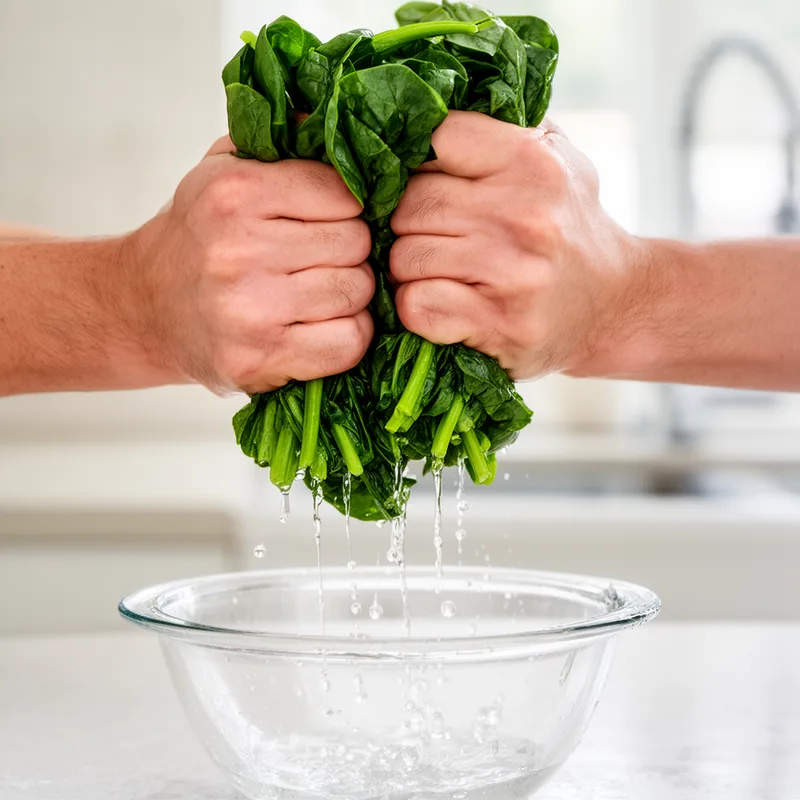
to press out
 1
4.1
1
4.1

- phrasal verb
- /prɛs aʊt/
- To make tofu, you need to press out the liquid by placing a weight on top of it.
- press out liquid
- press out excess moisture
- press out water
Examples
-
Definitely need to remember to press as much water out of the cooked riced cauliflower as possible. I was worried that mine wouldn't hold up, but it did, and it was fabulous!
Blog text (7) -
You just press out the moisture.
Blog text (19) -
So we're just kind of pressing it out, getting all that last little bit of good stuff out.
-
Sometimes I press the liquid out of the vegetables too.
Blog text (12) -
Mom: I always used paper towels to press out the moisture.
Blog text (19) -
If you live near the Mexican border or travel to Mexico, buy a tortilla press and use this to press out the water.
Blog text (19) -
Try pressing the liquid out of the cauliflower (gather it in several layers of paper towels and squeeze) after processing.
Blog text (7) -
Another way to get the extra moisture out of your grated potatoes is to put a couple of paper towels on top of a regular hand towel, cover them with a second paper towel, and use a rolling pin to press out the extra moisture.
Blog text (19) -
After boiling the vegetables, you should press out the excess water before serving.
-
Once the pasta is cooked, drain it well and press out any remaining liquid before adding the sauce.
Synonyms
 79
4.8
79
4.8
To force someone to do something or give you something
 70
4.1
70
4.1
To get a substance from a plant or material by a special process
 34
5.0
34
5.0
Push out a substance, for example gas from a body or container
 23
3.2
23
3.2
To remove liquid with a pump or make many things quickly
 20
4.1
20
4.1
Push a liquid or other substance out of something
 16
3.2
16
3.2
To move something outward using force
 13
4.1
13
4.1
Twist and squeeze cloth or clothes to remove water
 12
7.6
12
7.6
To force liquid out of something by squeezing it
 6
4.2
6
4.2
To push something out with effort or pressure
 5
3.3
5
3.3
Twist or squeeze a wet cloth to remove most of the water
 4
3.2
4
3.2
To press something to get liquid out
How Forceful
1
4.1

- Specialized
70
4.1
Surface Forms
Morphology
The meaning 'to extinguish by crushing' is directly inferable from 'press' (apply pressure) combined with the particle 'out' (indicating cessation or removal of the burning state); a B1 learner who knows both words can reasonably infer pressing something until it is 'out'. This follows common verb+particle composition patterns in English (e.g., 'put out') and is thus predictably compositional rather than idiomatic.
Etymology
Press out comes from the simple image of squeezing something so its liquid is forced out, like pressing spinach in a cloth or using a juicer for oranges. So, it means 'to get liquid or another substance from something by using force'.