
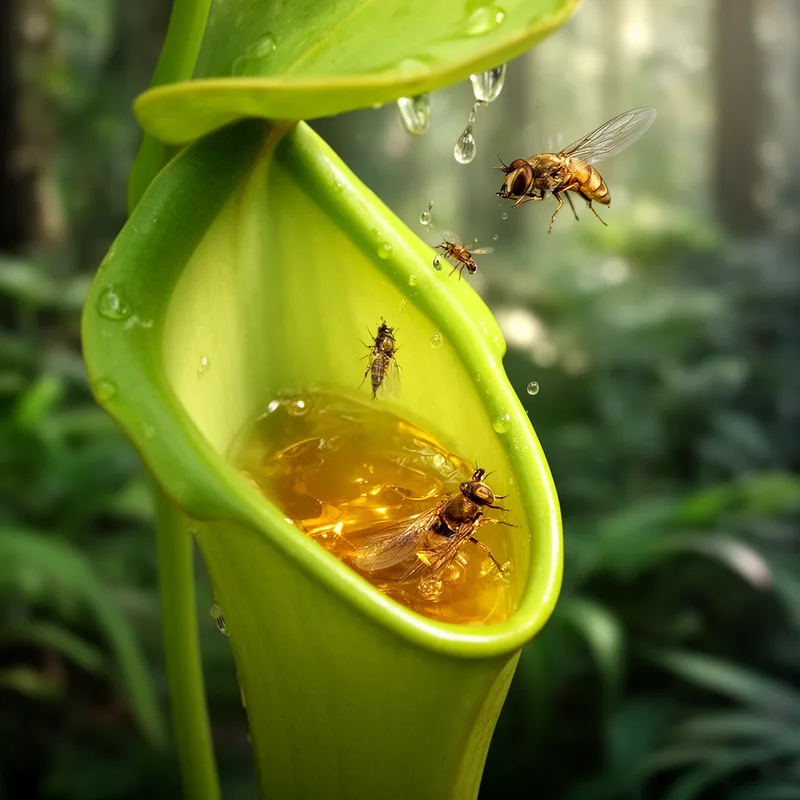
pitcher plant
 2
7.9
2
7.9

- noun
- /ˈpɪtʃər plænt/
- The pitcher plant uses its deep cavity filled with liquid to trap insects for nourishment.
- purple pitcher plant
- pitcher plant mosquito
Examples
-
Studying pitcher plants can help with this problem.
-
Bogbean, cinnamon fern, marsh cinquefoil, purple pitcher plant, round-leaved sundew, and several sedges cover most of the surface of the bog.
Academic text (2011) -
Do you know what species of pitcher plant this is?
Blog text (8) -
What remains, however, are representatives of the province's official flower: the pitcher plant.
Blog text (1) -
Even sundew and pitcher plants can be found.
Academic text (1998) -
I see that there's no sticky-note guide explaining how I can take care of my pitcher plant.
Blog text (8) -
Take this inhospitable bog, where pitcher plants reign supreme.
-
Indeed, the purple pitcher plant is common in the bogs of Newfoundland and has been designated the province's official flower.
Academic text (1992) -
The purple pitcher plant is a deathtrap for insects, millipedes, spiders, and even small frogs.
Academic text (1992) -
Bogs are home to a large number of carnivorous plant species, such as sundews, butterworts, bladderworts, and pitcher plants.
Academic text (2002)
How Carnivorous


Surface Forms
Morphology
The compound is compositionally built from 'pitcher' (a container or pitcher-shaped structure) + 'plant', so a B1 learner who knows both words can infer it is a plant with a pitcher-like cavity. Although the full botanical detail (that it is carnivorous and traps insects) may require extra knowledge, the core meaning of a plant characterized by a pitcher-shaped part is directly derivable from the constituents and is cross-linguistically transparent.
Etymology
Pitcher plant gets its name from the way its leaves form a deep cup like a pitcher that holds liquid. Insects slip inside and the plant 'traps and digests' them, so the name means a plant that catches insects for food.