
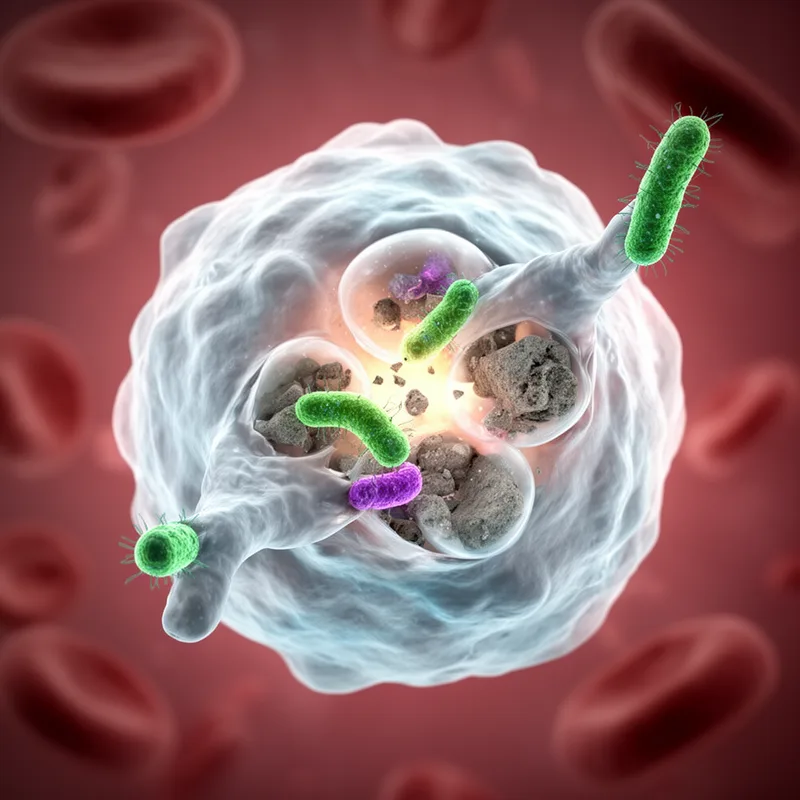
phagocytosis


 1
9.0
1
9.0
- noun
- /ˌfæɡəʊsɪˈtoʊsɪs/
- Specialized
- For example, HMB exposure increases macrophage proliferation and functionality as indicated through phagocytosis.
- impaired phagocytosis
Loading YouTube…
Watch on YouTubeAcute high blood sugar decreases your neutrophils chemotaxis, phagocytosis and bactericidal capacity.
- Acute high blood sugar decreases your neutrophils chemotaxis, phagocytosis and bactericidal capacity.
Examples
-
During phagocytosis, immune cells trap and destroy invading microorganisms to prevent infection.
-
One of the central ways by which neutrophils destroy bacteria is through phagocytosis, followed by fusion of the phagocyte with cytoplasmic granules.
Academic text (2018) -
Acute high blood sugar decreases your neutrophils chemotaxis, phagocytosis and bactericidal capacity.
-
Additionally, rounder particles are more apt to resist phagocytosis (5).
Academic text (2012) -
Although the molecular mechanisms are poorly understood, oxidative stress results in impaired phagocytosis and diminished pathogen clearance.
Academic text (2016) -
Phagocytosis in the bloodstream is impossible, and blood humoral bactericidal factors and erythrocytes are the main antibacterial forces in the bloodstream.
Academic text (2017) -
A history of diabetes is thought to exacerbate UTIs as glycosuria reduces phagocytosis and cellular immunity, encouraging bacterial adherence.
Academic text (2011) -
The process of phagocytosis helps remove dead cells and pathogens to keep the body healthy.
-
The rapid rate of phagocytosis by white blood cells is essential for fighting off infections.
How Complete
- Specialized
1
9.0

- Specialized
- Specialized
21
4.6
- Specialized
3
6.2
7
3.0
Surface Forms
Morphology
phagocytosis = phagocyte (opaque) = phago + cyto + osis
The formation 'phagocyte' + '-osis' is a regular scientific noun formation indicating a process, but it relies on technical combining forms unfamiliar to general learners.
Etymology
Phagocytosis comes from Greek parts phago- meaning 'to eat' and -cytosis meaning 'a process of cells'. So phagocytosis is like 'cells eating' and refers to how some cells 'eat' bacteria and waste to protect the body.