

to parry
 7
6.9
7
6.9

- verb
- /ˈpæri/
- Specialized
- Musashi parries the blow with the short sword, and then kills him with the right sword, finally defeating this unbeatable man.
- parries the thrust
- parry the blow
- parry an attack
Loading YouTube…
Watch on YouTubeYour instinct is not to slip or to parry or to get in a good position.
- Your instinct is not to slip or to parry or to get in a good position.
Examples
-
The captain looked for the lashing tentacles again, ready to parry, but no attack came.
Fiction book (1992) -
The Boss parried the stroke deftly and resumed his attack.
Fiction book (2001) -
Your instinct is not to slip or to parry or to get in a good position.
-
But VanOekel was able to get his hand up to parry the ball away.
Blog text (1) -
You lunge, you parry, you thrust.
-
He parried all of them.
-
All I could manage to do was parry away his thrusts and stabs and keep backing up toward the sea.
Fiction book (1999) -
D'Artagnan sees it in the nick of time, parries with his free hand, knocking the dagger to the rug.
Fiction book (1993) -
On the backswing, Ned parries with his own switchblade and flips Milo's knife away.
Fiction book (1993) -
In the fencing match, she quickly parried his attack with a swift movement of her sword.
Synonyms
 ∞
3.0
∞
3.0
To stop movement, access, or progress
 76
4.6
76
4.6
To turn attention away from a person or thing
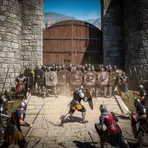 3
7.9
3
7.9
To drive back an attack or enemy force
Antonyms

Compounds

A small California bush with pink or white flowers, red berries, and reddish bark
How Effective

Surface Forms
Etymology
Parry as a verb comes from Old French parer 'to ward off' and the Latin parare 'to prepare', just like the English word prepare, so to parry is to block or turn aside an attack.