

orthogonal
 1
8.6
1
8.6

- adjective
- /ɔrˈθɒgənl/
- Specialized
- In force measurement systems, three channels are common, one for each of the three orthogonal directions.
- orthogonal directions
- orthogonal rotation
- orthogonal axes
Loading YouTube…
Watch on YouTubeThat one is orthogonal to the X&T;, and of course it's orthogonal to the normal XY plane.
- That one is orthogonal to the X&T;, and of course it's orthogonal to the normal XY plane.
Examples
-
Invariably, the plan of the new town was orthogonal, with two wide right-angled cross streets intersecting at a large central piazza.
Academic text (1994) -
That told us that the force is orthogonal to the velocity.
-
Because these are orthogonal to one another, they won't mix right.
-
The recent photo of the Hanford site shows the two orthogonal 4 km vacuum pipes going off into the distance.
Academic text (1999) -
The unit has application principally in force measurement, where force is to be measured in three orthogonal directions simultaneously.
Academic text (1995) -
The two lines on the graph are orthogonal, creating a clear intersection at a right angle.
-
To ensure accuracy, the sensors must be positioned in three orthogonal orientations: X, Y, and Z.
-
In the Cartesian coordinate system, the X and Y axes are orthogonal to each other.
Synonyms
 32
7.0
32
7.0
At a right angle to a line or surface
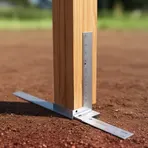
At a right angle to something

Lying across something at right angles
Antonyms

- Specialized
5
3.7
A line or flat surface the same distance from another that never meets it
Compounds

- Specialized
Two things that are at right angles to each other, like lines or vectors
Surface Forms
Morphology
orthogonal = ortho + gon + al
Formed from Greek combining forms (ortho- 'straight/right' + -gon- 'angle' + -al); the meaning 'at right angles' follows the parts but the combining forms are not common to B1 learners.
Etymology
Orthogonal comes from the Greek parts orthos meaning 'straight' or 'right' and gonia meaning 'angle'. So in geometry it literally means 'at a right angle', which is why we use it for lines or axes that meet at 90 degrees.