
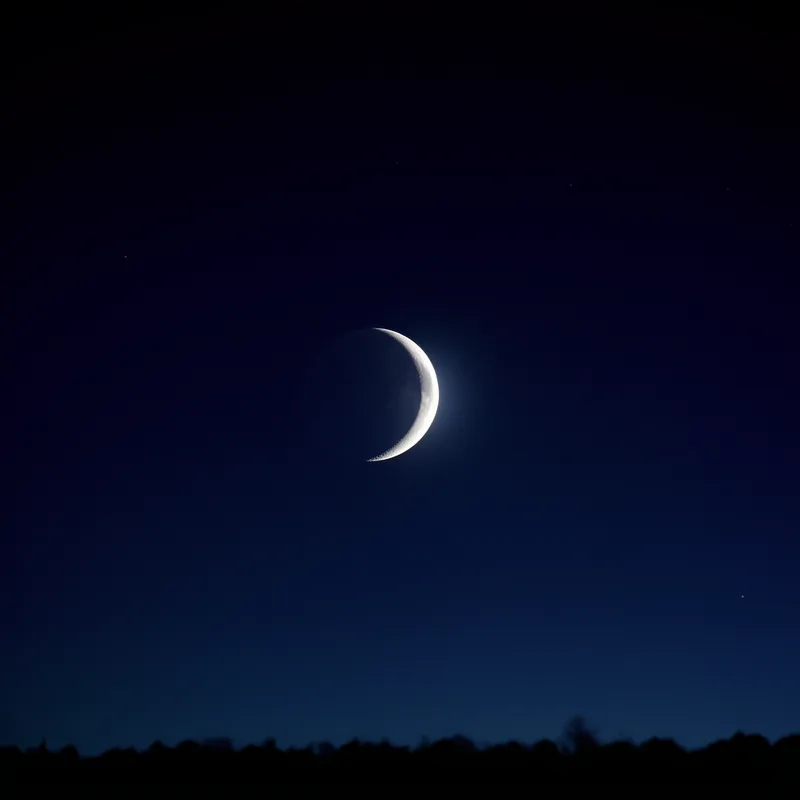
new moon
 9
2.8
9
2.8

- noun
- /nuː muːn/
- I hope after the new moon I can get back to it.
- rising of a new moon
Loading YouTube…
Watch on YouTubeNow we know that the moon goes through phases, we see full moon, Half Moon, quarter moon, Crescent moon, new moon.
- Now we know that the moon goes through phases, we see full moon, Half Moon, quarter moon, Crescent moon, new moon.
Examples
-
If your trip coincides with the new moon, definitely go (and dress warm!).
Blog text (10) -
There were stars and a new moon in an indigo sky.
Fiction book (1998) -
I have seen the new moon, but not you.
-
Today, a new moon is in the sky.
-
I shall be waiting for him... here... at new moon in April.
-
But it was the new moon, and her mother was expecting her for her monthly visit.
Fiction book (2001) -
"Oh, dear, and here it is, the tenth day after the new moon.
Fiction book (1999) -
That's the phase cycle of the moon from new moon through full moon back to new moon.
-
It was a new moon when I first came to the Franklin Inn.
-
Tonight, the new moon is only a thin crescent lighting up the dark sky.
Synonyms

A time when the Moon looks like a thin crescent at the start of a new moon cycle
Antonyms
How Illuminated
- Archaic

 1
2.4
1
2.4

- Specialized
2
8.8
- Specialized
20
3.2
30
3.5
9
2.8
Surface Forms
Morphology
The compound is largely compositional — 'new' + 'moon' yields the idea of a moon that is newly appearing, and many languages use an equivalent term (e.g. Spanish 'luna nueva'), so a learner can get a basic sense from the constituents. However, the precise astronomical sense (the specific phase timing and visibility conditions) is conventional and somewhat technical, so a B1 learner who only knows the words may not derive the full, specialised meaning without exposure.
Etymology
The noun new moon names the moment when a thin bright crescent of the moon appears after the moon has been hidden. People called it new because it looks like the Moon is 'starting' again, so today new moon means the first visible crescent or the time it appears.