
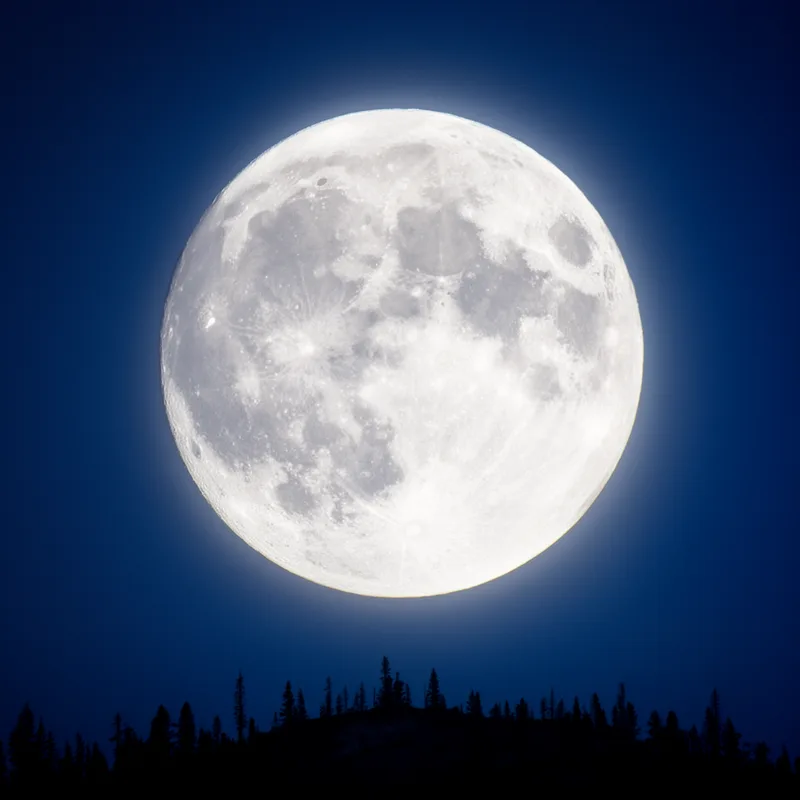
full moon
 116
1.2
116
1.2

- noun
- /fʊl muːn/
- The ideal field trip was taken on the evening before the full moon in October.
- see the full moon
- the full moon rises
- bright full moon
Loading YouTube…
Watch on YouTubeWhen they say there's a full moon, people go off.
- When they say there's a full moon, people go off.
- It's like full, it's almost like a full moon, but all day long.
- And so every month on the full moon, the town like locks down.
- It depends on the what's called the first full moon after the spring equinox.
- I was so excited to see my first full moon.
- Like her magic is strongest at the full moon, right?
- Oh, of all the moons of the year and they all have names, The name of the full moon in June is the honeymoon.
- What he does is when it's a full moon, he crunches over.
- She's like, it's, it's just a full moon and I'm like, what?
- I was in the middle of the woods looking at the full moon, tripping mad balls.
Examples
-
Is today the day of the full moon?
-
The evening is perfectly clear, and there is a full moon rising slowly and large behind them.
Fiction book (1991) -
So first of all, the full moon at night is crazy bright.
-
And every time I look at the full moon, I think, wow, we put people on the moon.
-
Then she realized it was the full moon rising on the eastern horizon.
Fiction book (1994) -
By the light of the full moon, she and Glenn took an ambulance to the hospital.
Academic text (2001) -
Now the light of the full moon gleamed on the glass walls of the greenhouse.
Fiction book (1994) -
The full moon illuminated the night sky, creating a beautiful scene for everyone to see.
-
On the evening of the full moon, people gathered outside to admire its bright glow.
-
The full moon is a perfect time for stargazing, as its light can make other stars harder to see.
Synonyms

 1
2.4
1
2.4
The time when the Moon looks completely round and bright
The time when the Moon looks fully round and very bright

A time when the Moon looks completely lit in the night sky
Antonyms

How Bright

Surface Forms
Morphology
The meaning is directly compositional: 'full' (completely filled/entire) + 'moon' (Earth's satellite) yields the phase when the Moon appears fully illuminated. This construction is semantically transparent and has clear cross-linguistic parallels (e.g. Spanish 'luna llena', French 'pleine lune'), so a B1 learner who knows both words will readily infer the meaning.
Etymology
Full moon comes from the sight of the moon looking completely full and bright when the sun lights its whole face. That's why 'full moon' means the time when the moon's whole face is visible and shines at night.