
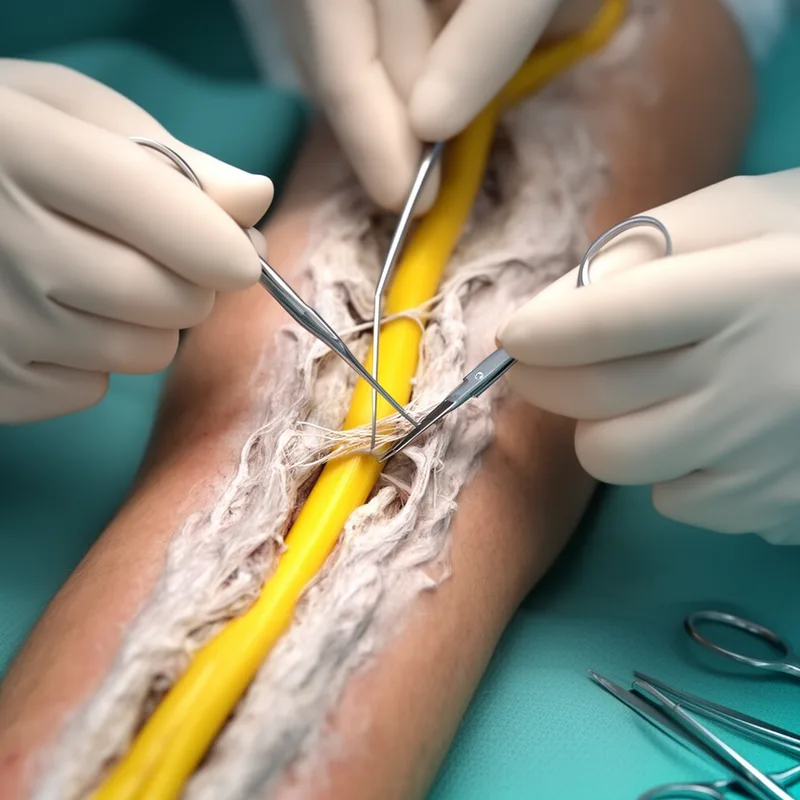
neurolysis
- noun
- /nʊˈrɑːlɪsɪs/
- Specialized
- During the consultation, the specialist explained that neurolysis could help restore function by freeing the nerve from surrounding adhesions.
Examples
-
Three months after injury, i.e., one month after being seen in our department, the patient was admitted for neurolysis of the ulnar nerve and corrective osteotomy of the radius under general anaesthesia.
Academic text (2007) -
In this article, we make only brief mention of the effectiveness of decompression, neurolysis, and grafting for traumatized facial nerves.
Academic text (2004) -
In the latter four patients, progressive ulnar nerve palsy developed after manual reduction, and neurolysis was performed 10 to 16 weeks thereafter.
Academic text (2007) -
This can be performed as an open procedure or by microsurgical or endoscopic techniques, with or without epineurotomy or intraneural neurolysis (30).
Academic text (2015) -
Published reports range from recommendations of observation with no action or a simple biopsy to microsurgical intraneural neurolysis and/or CTR.
Academic text (2015) -
When external neurolysis was advanced, the nerve showed marked adhesion to the periosteum at a more proximal site (Fig. 3b).
Academic text (2007) -
The surgeon performed a neurolysis to relieve the pressure on the patient's compressed nerve.
-
After the injury, the doctor recommended neurolysis to remove the scar tissue wrapping the nerve.
Synonyms
A surgery that fixes damaged nerves to restore movement or feeling
How Invasive
- Specialized

- Specialized
- Specialized
- Specialized
Surface Forms
Morphology
Etymology
Neurolysis comes from neuro- meaning 'nerve' and -lysis meaning 'loosening' or 'freeing', a root also found in dialysis. So, in surgery it often means 'freeing' a nerve from scar tissue or tight structures so it can work without pain.

