

myrrh tree
- noun
- /mɪr/
- Traders once traveled great distances to harvest resin from the myrrh tree.
Examples
-
The myrrh tree grows well in arid climates.
-
The ancient Egyptians valued the myrrh tree for its fragrant resin.
-
A myrrh tree can thrive in arid regions with little rainfall.
-
Many myrrh trees can be found in Somalia.
-
The myrrh tree grows well in dry, rocky soils where it can thrive under harsh conditions.
-
Ancient Egyptians extracted resin from the myrrh tree to use in burial rituals and perfumes.
-
The fragrance of the myrrh tree's resin is popular in incense and spiritual ceremonies.
Synonyms

A small tree from eastern Africa and Asia that makes fragrant resin used in perfume, incense and medicine
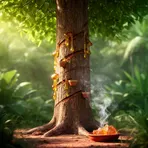
A tropical tree that makes fragrant sap burned for its smell
Surface Forms
Morphology
The meaning is directly compositional: 'myrrh' names the aromatic resin and 'tree' names the plant, so 'myrrh tree' denotes a tree that produces or yields myrrh. This product+tree noun-compound pattern (like 'olive tree' or 'lemon tree') is common and predictable, so a learner who knows both constituents will readily infer the MWE's meaning.
Etymology
Myrrh tree is the name for a small tree that makes a sticky, fragrant gum called myrrh. People long ago burned this gum as 'perfume' and 'incense', so the name reminds us of a plant that gives a useful, sweet smell.

