
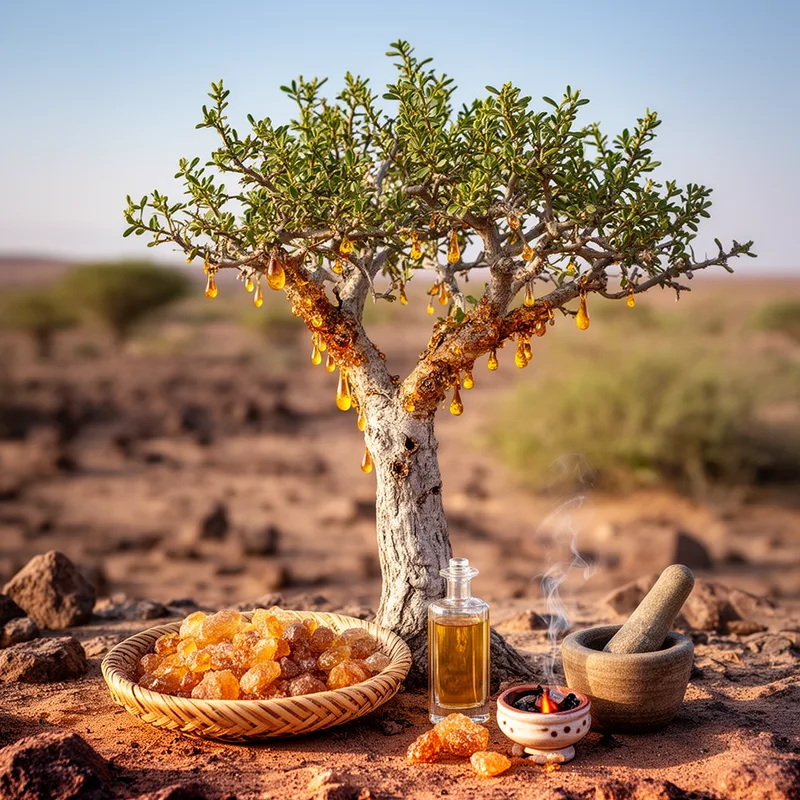
Commiphora myrrha
- noun
- Specialized
- The resin from the Commiphora myrrha tree has been prized since ancient times for its fragrance.
Examples
-
Commiphora myrrha grows in arid regions and produces the valuable substance known as myrrh.
-
Researchers studied the medicinal properties of Commiphora myrrha in traditional herbal remedies.
-
The Commiphora myrrha tree thrives in arid climates.
-
Many traditional medicines use Commiphora myrrha for its healing properties.
-
Commiphora myrrha is often used in perfumes due to its aromatic resin, which has a rich history in fragrance production.
-
Commiphora myrrha trees are known for their ability to survive in dry environments and produce the sought-after resin myrrh.
-
The therapeutic benefits of Commiphora myrrha are recognized in many cultures, particularly in traditional medicine practices.
Synonyms
A small tree from eastern Africa and Asia that makes a sticky fragrant substance used in perfume and incense

A group of trees and shrubs from Africa and India that make a scented resin like myrrh
Surface Forms
Morphology
Commiphora + myrrha
This is a Latin binomial composed transparently from the genus name 'Commiphora' (a group of resin-producing trees) and the species epithet 'myrrha' (relating to myrrh), so a learner who knows both constituents can infer it is the Commiphora species associated with myrrh. Scientific naming is a regular compositional pattern, making the specific meaning predictable from the parts rather than idiomatic or metaphorical.
Etymology
Commiphora myrrha is the tree that makes myrrh, a strong-smelling resin that oozes from the bark and was burned or used as 'perfume', incense, and medicine in ancient times. That's why the name points to a tree valued for its fragrant, useful resin.

