
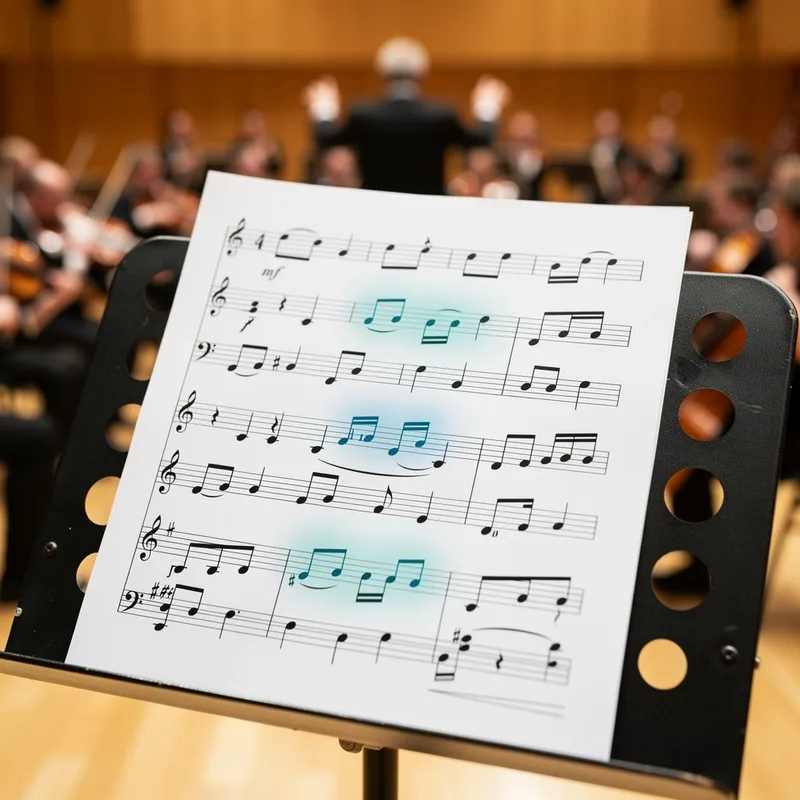
motive
 6
7.4
6
7.4

- noun
- /ˈmoʊtɪv/
- Specialized
- Each section of the piece features a distinct motive that adds to its overall theme.
- a musical motive
- a repeated motive
- a rhythmic motive
Examples
-
When working with vocalists, start with short motives and then go on to phrases.
Academic text (1996) -
Composing ostinatos to accompany familiar songs is easy if a motive from the song is used.
Academic text (1997) -
Ask each student to play his or her musical motive for the class.
Academic text (2011) -
So no introduction just starts off with his first motive there, our four note motive.
-
In this strategy, the motive may be melodic and left to the students to create.
Academic text (1992) -
And basically what I would like for you to do is, is to take some of the motives from the melody.
-
Challenge students to dissect the original motive into pitch and rhythm.
Academic text (1996) -
Students will quickly see how their short motives can be layered into the larger coherent musical structure.
Academic text (2011) -
The composer introduced a memorable motive that recurred throughout the symphony.
-
During the lesson, the teacher explained how to develop a musical motive into a full composition.
Synonyms
 173
3.4
173
3.4
A melody that repeats and becomes the main musical idea
 88
7.5
88
7.5
A short melody that returns and changes in a musical piece
 3
6.7
3
6.7
A short musical idea that repeats and is changed in a piece
 1
9.1
1
9.1
A short musical idea that returns to show a person, place, or feeling
 1
3.4
1
3.4
The main tune that represents a person or idea in a piece of music
 1
3.4
1
3.4
A short group of notes that sounds complete in a piece of music


 1
9.9
1
9.9
A short tune that comes back in music to represent a person or idea
 1
5.8
1
5.8
A main tune that returns and shapes a musical piece
Compounds




How Prominent

Surface Forms
Etymology
Motive comes from the Latin root movere meaning 'to move', and in music it names a short idea that helps 'move' the piece forward. Think of a motive as a small musical idea that repeats and pushes the music along.