

mitosis
 7
5.5
7
5.5

- noun
- /maɪˈtoʊsɪs/
- Specialized
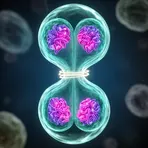
- Completion of mitosis via cytokinesis results in two daughter cells.
- cells undergoing mitosis
- mitosis and meiosis
- kinetochores during mitosis
Loading YouTube…
Watch on YouTubeThey generate this light and that causes cell division, mitosis and meiosis to occur.
- They generate this light and that causes cell division, mitosis and meiosis to occur.
- Cells grow right as turn about as far as like mitosis, they divide, correct right now.
Examples
-
Mitosis is essential for growth, as it allows a single cell to divide into two identical mitosis.
-
First, when a cell enters the process of mitosis, it already has twice the DNA that it needs.
-
And so the cellular response would be mitosis, right?
-
Another group was working with their biology teacher on finding images to explain mitosis for a video project.
Academic text (2011) -
They're both still going to undergo mitosis, OK.
-
Turns out that yeast can also undergo mitosis as a haploid.
-
Using the acronym PMAT helps students remember the phases in cell mitosis.
Academic text (2002) -
In this phase, the zygote divides by mitosis in a row to 2-4-8-16 and finally 32 cells.
Blog text (6) -
Mitosis is a form of cell division in which a eukaryotic cell divides the chromosomes into two identical nuclei, whereas meiosis is a process that halves the nucleus requiring additional division...
-
During mitosis, the genetic material is replicated and divided, resulting in two nuclei with the same chromosome count.
Synonyms
 5
2.8
5
2.8
A cell splits to make two new cells for growth or repair

 1
3.8
1
3.8
A process in which a cell splits to make two or more new cells for growth and reproduction
Surface Forms
Morphology
mitosis = mito (opaque) = mito + sis
The combining form 'mito-' is a technical Greek-derived element (not a familiar standalone English word) and the suffix '-sis' is a specialist noun-forming suffix, so the formation is not transparently meaningful to an average B1 learner.
Etymology
Mitosis comes from the Greek root mitos, which means 'thread', plus the ending -osis, which means 'process'. Scientists used this image because chromosomes look like tiny threads that are pulled apart into two new nuclei, so mitosis is the 'thread-like' process of cell division.