
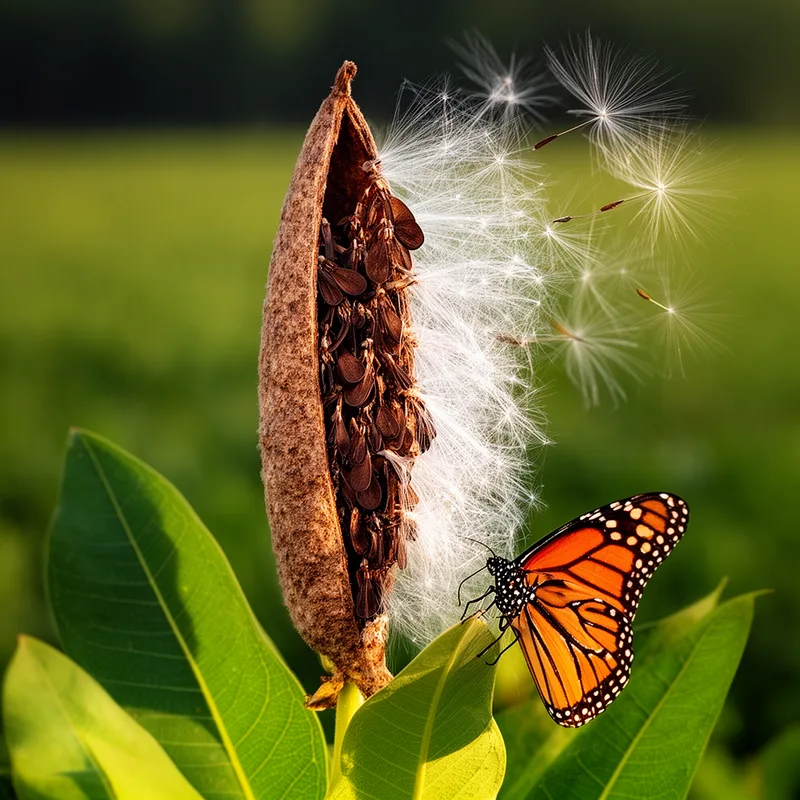
milkweed
 7
7.9
7
7.9

- noun
- /ˈmɪlkˌwiːd/
- US
 :
algodoncillo
:
algodoncillo
- In their rented farmhouse there, the windows collected sunshine from surrounding fields full of milkweed, daisies, and buttercups.
- milkweed leaves
- milkweed plant
- common milkweed
Or you know, maybe you want more varieties of Asclepius of milkweed.
- Or you know, maybe you want more varieties of Asclepius of milkweed.
Examples
-
The insects that consume milkweed occupy just about every conceivable feeding niche.
Academic text (2002) -
As this issue goes to press, silky milkweed seeds are bursting out of their crescent-shaped pods.
Academic text (2002) -
Was there any Johnson grass or milkweed around?
-
Dear me, I almost forgot to put out the pitcher plant, and the milkweed is coming with butter and eggs!
Fiction book (1997) -
Monarch caterpillars feed exclusively on leaves of milkweed plants, which grow in and around cornfields.
Academic text (2002) -
To find out, the researchers established corn pollen density and distribution patterns on milkweed leaves near cornfields.
Academic text (2002) -
Small milkweed bugs (Lygaeus kalmii) can sometimes be found in large numbers on milkweed plants, where they mate.
Academic text (2002) -
A monarch caterpillar creates its own window of opportunity on the leaf of a swamp milkweed, Asclepias incarnata.
Academic text (2002) -
In particular, they say, herbicide use on Midwest farmland destroys many milkweed plants on which monarch larvae grow.
Academic text (1999) -
Many gardeners choose to plant milkweed to support the declining monarch butterfly population.
Synonyms
A plant with milky juice and seed pods that release fluffy seeds

A group of flowering plants with milky sap called milkweeds
Compounds

- Specialized
1
9.9
A rare flowering plant that lives many years in central North America and is now threatened


A large orange and black North American butterfly whose caterpillars eat milkweed

A tall plant that lives for many years and has bright orange flowers that attract butterflies

A milkweed plant from eastern North America with white and green flowers that grows in shady woods

A milkweed plant from the southwestern United States and Mexico that makes farm animals very sick


A plant with large purple and pink star-shaped flowers that attract butterflies

- Specialized
A tall desert plant from the southwestern United States with white leafless stems and pale star-shaped flowers

A flowering plant with narrow leaves that grow in rings around the stem and small greenish-white flowers
Surface Forms
Morphology
Etymology
The word milkweed is made of milk and weed because the plant has a white 'milky sap' and grows as a wild plant. So, a milkweed is a wild plant known for its milk-like sap and its silky seeds.