

mercury chloride
- noun
- /ˈmɜrkjʊri klɔrˈaɪd/
- Specialized
- Mercury chloride is highly toxic, and safety precautions should be taken when handling mercury chloride.
Examples
-
The pesticide contained mercury chloride, making it effective against various pests but also dangerous.
-
In laboratories, mercury chloride is often used as an antiseptic due to its harmful properties.
-
However, mercury and mercury chloride emissions are difficult to remove and are more effectively controlled with scrubbers than with ESPs.
Academic text (1993) -
Heavy metals such as zinc, lead, cadmium, mercury, and arsenic volatilize in elemental form, although mercury is often present as mercury chloride.
Academic text (1993)
Synonyms
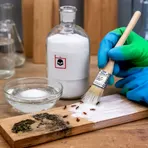
A white poisonous chemical used to kill pests and preserve wood

A poisonous white chemical once used to kill pests, clean wounds, and protect wood
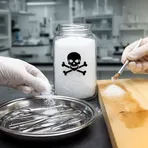
A white poisonous chemical once used to kill germs and protect wood
Surface Forms
Morphology
The term denotes the chloride compound of mercury and is compositionally derived from 'mercury' + 'chloride', following standard chemical naming conventions; a B1 learner who knows both constituent meanings can infer it is a chemical combination of mercury and chlorine. While detailed properties (white crystalline form, uses, toxicity) are specific and not fully deducible, the core referent as a mercury–chlorine compound is transparently expressed and recognizable across languages.
Etymology
Mercury chloride is named for how it is made: the heavy metal mercury joins with chloride to form white crystals. Those crystals are very poisonous but were once used to kill germs and protect wood, so the name points to a dangerous chemical used as a 'preservative' and 'antiseptic'.

