

corrosive sublimate
- noun
- /kəˈroʊsɪv ˈsʌblɪmeɪt/
- Archaic
- Laboratory safety protocols strictly prohibit the use of corrosive sublimate due to its high toxicity.
Examples
-
Wooden artifacts were once preserved using corrosive sublimate, but safer chemicals are now preferred.
-
The laboratory used corrosive sublimate for its experiments.
-
In the nineteenth century, corrosive sublimate was commonly used to disinfect surgical instruments.
-
Many farmers avoided corrosive sublimate due to its toxicity.
-
Corrosive sublimate can be highly toxic and should be handled with care in any laboratory.
-
Farmers used to apply corrosive sublimate to control pests in their crops before safer alternatives were discovered.
-
The old book about chemistry warned that corrosive sublimate could cause severe burns if it came into contact with skin.
Synonyms
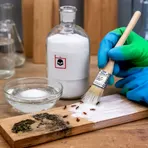
A white poisonous chemical used to kill pests and preserve wood

A poisonous white chemical once used to kill pests, clean wounds, and protect wood

A poisonous white chemical once used to kill pests and preserve wood
Surface Forms
Morphology
The term transparently combines 'corrosive' (chemically destructive) and 'sublimate' (a substance condensed from vapor), so a learner who knows both words could infer it denotes a corrosive substance formed by sublimation. However, this is a technical, historical chemical name referring specifically to mercuric chloride with poisonous properties, so the precise referent and full implications are not fully predictable from the parts alone.
Etymology
Corrosive sublimate comes from old chemistry: people heated mercury salts until they turned into vapor and formed shiny white crystals called a sublimate. Because these crystals would 'eat away' materials and were very poisonous, the word corrosive was added, so the name now means the white, toxic mercury chemical once used to clean instruments and kill bugs.

