
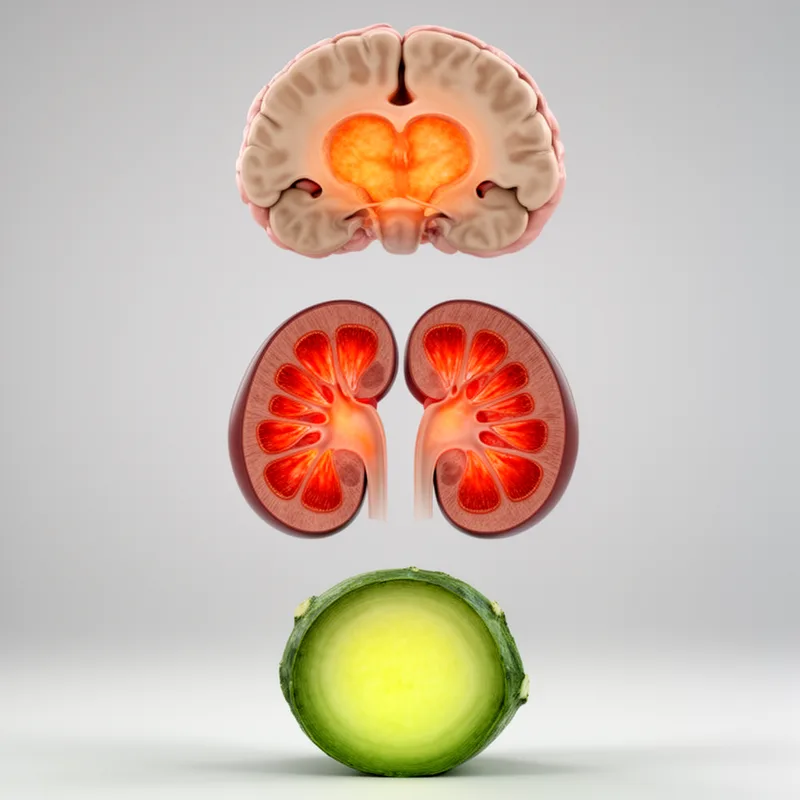
medulla
 1
8.4
1
8.4

- noun
- /məˈdʌlə/
- Specialized
- However, by postnatal day 16, Ace -/- mice exhibit expansion of the renal pelvis and underdevelopment of the renal medulla 19.
- renal medulla
Examples
-
It takes a turn deep in the medulla and starts coming back up again and and heads back up to the distal convoluted tubule.
-
We tested changes in the whole kidney, but not separately cortex, medulla, or specific renal cell populations.
Academic text (2018) -
Examples are the brain, renal medulla, red blood cells, and the testes.
-
The answer is that it does, because there is one place in mammals where the internal environment has striking similarities to that of a cartilaginous fish—namely, the renal medulla.
Academic text (1991) -
Methylamines have also been found in the medulla of the mammalian kidney (where urea concentrations are high) and in the plasma of human subjects with chronic renal failure.
Academic text (1991) -
MICROSCOPIC EXAMINATION OF THE CUTICLE, THE CORTEX, AND THE MEDULLA OF THE HAIR WILL REVEAL THEM TO BE HUMAN IN ORIGIN.
-
Increased catecholamine secretion in blood by the adrenal medulla stimulating the adrenergic receptors in the heart may be an alternative factor that contributes to the observed increase in HR (28).
Academic text (2000) -
Blubber specimens consisted of whole thickness sections of blubber from the skin to the muscle, while kidney specimens consisted of whole kidney tissue (cortex and medulla).
Academic text (2000) -
The outer portion of the cerebrum is called the cortex, and the inner part is called the medulla.
-
The substance of the ovaries is distinctly divided into an outer cortex and an inner medulla.
Antonyms

Compounds

- Specialized
2
6.9
The lower part of the brain that controls breathing, heartbeat, and blood pressure
- Specialized
The inner part of the small gland above each kidney that makes stress hormones like adrenaline

- Specialized
The part of the nervous system inside the spine that carries messages between the brain and the body
Surface Forms
Etymology
Medulla comes from the Latin word medulla, meaning 'marrow' or the soft inner core of a thing. So the medulla of a plant or organ is simply its inner region or centre, where key work like nutrient movement or concentration often happens.