
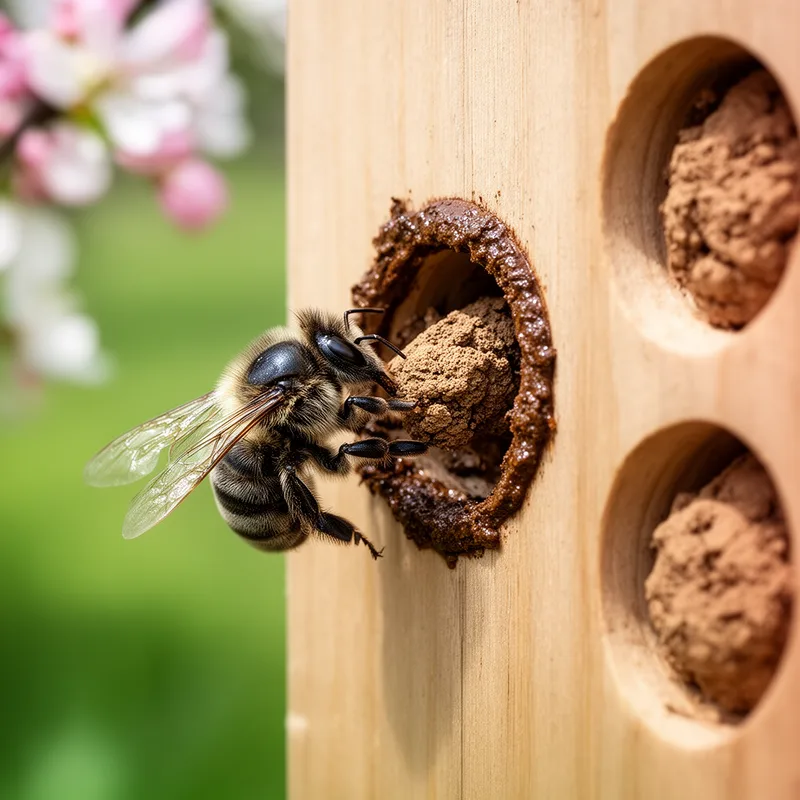
mason bee
- noun
- /ˈmeɪsən bi/
- I spotted a mason bee near the flower bed.
- orchard mason bee
Examples
-
The mason bee uses mud to carefully seal each chamber of its nest.
-
Gardeners encourage mason bees to improve pollination in their orchards.
-
Unlike honey bees, the mason bee leads a solitary life.
-
The mason bee is a vital pollinator in gardens.
-
Mason bees build their nests using mason bee mud and sand in hollow stems.
-
To encourage mason bees in your garden, consider creating small holes in wooden blocks for their nests.
-
During spring, you can often see mason bees foraging for nectar among the flowers.
Synonyms
A bee that lives alone and builds mud nests on plants
Surface Forms
Morphology
The compound 'mason bee' transparently combines 'mason' (a builder who works with stone/brick) and 'bee' (an insect), so it straightforwardly denotes a bee that builds/uses masonry-like materials for nests. This noun-noun compounding follows a common, compositional English pattern, so a B1 learner who knows both constituents would likely infer the intended meaning.
Etymology
The name mason bee comes from the bee's habit of using mud to make and seal small nest rooms, like a human mason who builds with bricks. So the name points to a solitary bee that 'builds' its nest from mud.

