

to make believe
 17
3.8
17
3.8

- phrasal verb
- /meɪk bɪˈliːv/
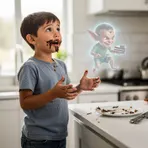
- Close your eyes and make believe you are far away.
Examples
-
So, you guys played make believe?
-
I used to make believe a lot when I was a kid.
-
Did you make believe you had a pretend friend?
Fiction book (2001) -
It's a place of escapism to make believe island, you know.
-
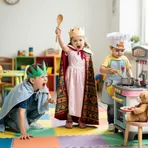
We've all played make-believe with our children, and the difference ought to be pretty evident.
Blog text (12) -
Children love to make believe they are superheroes while playing in the park.
-
During the play, the actors had to make believe they were living in a different era.
-
When it rains, we often make believe we are in a cozy cabin by the fireplace.
Synonyms
 ∞
1.3
∞
1.3
To form a picture in your mind of something not real
 ∞
2.5
∞
2.5
Behave in a way to trick or amuse someone
 ∞
8.1
∞
8.1
To pretend to be someone or something else
 ∞
2.3
∞
2.3
To act as if something is true when it is not
 972
3.2
972
3.2
Invent a story or excuse that is not true
 126
4.5
126
4.5
To imagine things that are not real because you want them
 27
6.0
27
6.0
To pretend or claim something is true when it is not
 20
6.7
20
6.7
Pretend to have a feeling to trick people
 11
5.0
11
5.0
Pretend to have a quality or feeling
 4
2.9
4
2.9
Act as if you are someone or something imaginary
 2
6.1
2
6.1
To act out a scene to practice or show how something happens
Antonyms
How Real

Surface Forms
Morphology
make + believe
The meaning 'to pretend' is directly derivable from combining 'make' (to cause or create) with 'believe' (to accept as true): to 'make [something] be believed' corresponds to acting as if something is true. This compositional pattern (compare Spanish 'hacer como si', French 'faire semblant', Japanese 'ふりをする') is common, so a B1 learner who knows the constituents will typically infer the intended meaning.
Etymology
Make believe comes from the simple idea of using make and believe together: you 'make' something look true so others 'believe' it, like children who turn a box into a pirate ship and act as if it is real. That's why make believe means 'to pretend'.