

major key


 1
4.9
1
4.9
- noun
- /ˈmeɪdʒər ki/
- Specialized
- So in a major key, let's say you've got F aeolian.
Examples
-
Eric plays the guitar loud, the Shelly theme in a major key.
Fiction book (1994) -
We now ask the students to open the required sight-singing book 4 and turn to the section containing stepwise melodies in major keys.
Academic text (2006) -
The first tune came from a bird call I'd never heard before: cheery, pert, and in a major key.
Blog text (29) -
One of the advantages of the movable do system over the fixed do system is its ability to highlight the harmonic function of each note in a scale (for example, in a major key, do is always the tonic).
Academic text (1998) -
Section "B1" has the second melody in a major key, with variations and blues-like accents and growls, and section "B2" presents a variation on the second melody.
Academic text (1999) -
They also learn the makeup of various tonal functions within those tonalities; for example, a tonic pattern in a major key consists of some arrangement of do, mi, and sol.
Academic text (1999) -
The song has a bright sound because it is played in a major key.
-
Many popular songs today are composed in a major key to create a happy mood.
-
The piece transitions smoothly from a minor key to a major key, lifting the overall feel.
Synonyms
 1
3.7
1
3.7
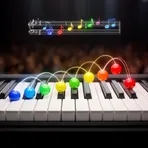
A set of seven notes with whole steps except half steps between the third and fourth and seventh and eighth
 1
6.3
1
6.3
A way of using the major scale in music that sounds bright and happy
A common eight-note pattern in Western music with small steps between third and fourth and seventh and eighth

The main note and scale that a piece of music returns to
Antonyms

How Bright
- Specialized
1
4.9
 2
5.9
2
5.9
Surface Forms
Morphology
The meaning is directly compositional: 'major' (the major scale / brighter, happier mode) modifies 'key' (tonality), so a B1 learner who knows both senses can infer a musical key based on the major scale. This pattern is cross-linguistically common in musical terminology and follows normal adjective+noun composition, making the phrase predictable rather than idiomatic.
Etymology
The term major key comes from the word major, which means 'bigger' or 'greater', and from the major scale that uses bigger steps between some notes to make a brighter sound. That's why music in a major key feels 'happy' or uplifting.