
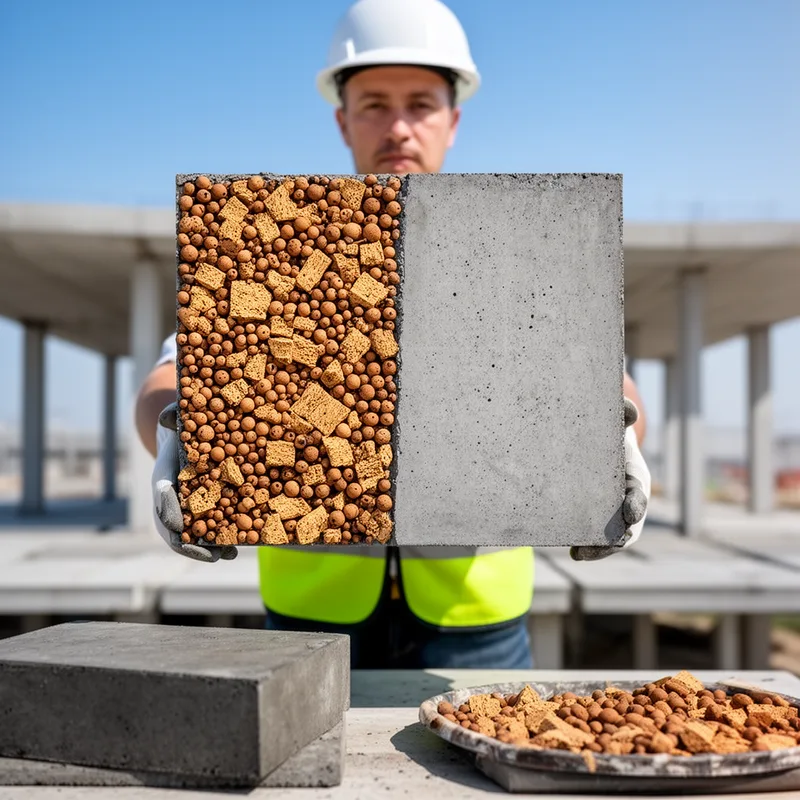
lightweight concrete
- noun
- /ˈlaɪtˌweɪt ˈkɒnˌkriːt/
- Specialized
- His research interests include developing and investigating the structural performance of self-consolidating concrete, semi-lightweight and lightweight concrete, and rubberized concrete. Assem A. A. Hassan is an Assistant Professor in the Faculty of Engineering and Applied Science at Memorial University of Newfoundland.
Examples
-
Builders often use lightweight concrete for its easier handling and reduced transportation costs.
-
The use of lightweight concrete can improve energy efficiency in buildings due to its insulating properties.
-
For the construction project, the team decided to use lightweight concrete to ensure the structure would be durable yet easy to manage.
Synonyms

A light building material made by trapping air bubbles in a mix of cement and small stones

A type of concrete that has different weight by adding air or light pieces like clay and cork

Lightweight building material with many small air pockets that keep heat in or out

A light type of concrete that has many small air bubbles

A very light building material that has many small air bubbles

Concrete that lets water pass through and is used to reduce flooding
How Heavy
- Specialized

- Specialized
Surface Forms
Morphology
The meaning 'concrete that is lower in mass than conventional concrete' is directly and compositionally derived from combining 'lightweight' (comparatively low in physical mass) with 'concrete' (a building material). This straightforward adjective+noun pattern follows normal English composition and is cross‑linguistically predictable, so a B1 learner who knows both constituents would readily infer the meaning.
Etymology
Lightweight concrete is named for making concrete with lightweight pieces instead of heavy stones. Builders mix in light bits like burned clay or cork so the material is 'lighter', which is why it is used to reduce the weight on a building and to help keep heat in.

