
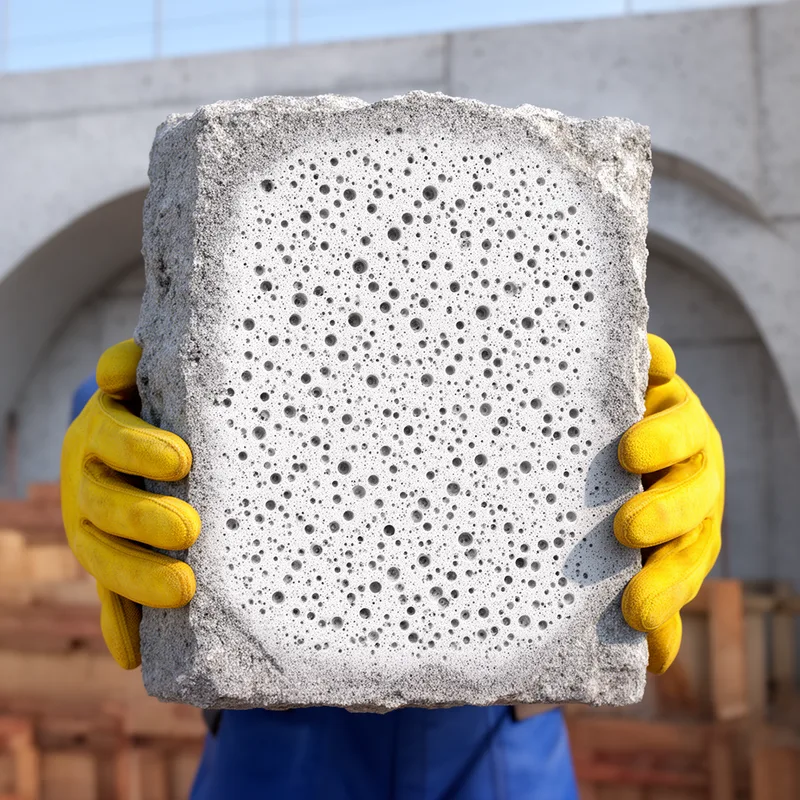
foamed concrete
- noun
- /foʊmd ˈkɒnˌkriːt/
- Specialized
 :
hormigón espumado
:
hormigón espumado
- The new building uses foamed concrete to improve insulation and reduce structural weight.
Examples
-
With the addition of air bubbles, foamed concrete offers excellent thermal and acoustic properties.
-
Engineers chose foamed concrete because it is easy to pour and shapes well for unusual designs.
-
The contractor used foamed concrete for the lightweight walls.
-
Many builders prefer foamed concretes due to their insulation properties.
-
Engineers chose foamed concrete because it is lightweight and suitable for unique architectural designs.
-
The new building utilizes foamed concrete to enhance insulation while reducing overall weight.
-
With its air-entrained bubbles, foamed concrete provides excellent thermal insulation and soundproofing.
Synonyms

Lightweight building material with many small air pockets that keep heat in or out

A light building material made by trapping air bubbles in a mix of cement and small stones
How Lightweight
- Specialized

- Specialized
- Specialized
Surface Forms
Morphology
The meaning is directly and compositionally built from 'foam' (bubbles/air) + 'concrete' (building material): it denotes concrete that contains foam/air and is therefore porous and lightweight. This is a transparent, productive technical compound (similar to 'aerated concrete' in other languages), so a B1 learner who knows both constituents can infer the meaning.
Etymology
Foamed concrete is named for the simple idea that builders mix foam full of 'air bubbles' into wet concrete, making it much lighter and better at keeping heat in, and that's why the name means a light, insulating type of concrete.

