

lichen
 9
7.5
9
7.5

- noun
- /ˈlaɪkən/
- Specialized
- Reindeer were winter-loving animals, feeding on lichens that grew on barren soil and rocks.
- lichen thallus
- fruticose lichen
- lichen fungus
Loading YouTube…
Watch on YouTubeWell, they get it from the the, the lichen that's digested in reindeer stomachs.
- Well, they get it from the the, the lichen that's digested in reindeer stomachs.
- And it's also found in, in animal products and found in plant lichen, which is a type of algae.
- That means bringing in life plants, lichens, molds, all sorts of, you know, bacteria, and ultimately changing it so that it will work for humans.
Examples
-
Some species of lichen can survive in extreme environments, like deserts or icy regions.
-
I saw bright green lichen growing on the rocks in the forest.
-
And this is some lichen on a bench, apparently.
-
A patch of the necessary lichen covered the top lip of a particularly precarious rock.
Fiction book (1994) -
During my journeys, I have encountered diverse lichen species on all five continents of our globe.
Academic text (2000) -
As the climate warms, lichens' ranges, too, may be pushed farther north.
Academic text (2012) -
The camera-wearing caribou mostly fed on ground and arboreal lichens and occupied black spruce habitats.
Academic text (2012) -
The old tree was covered in various colors of lichen, creating a beautiful pattern.
Compounds


- Specialized
A skin disease that causes shiny, flat, purple, itchy bumps on the wrists or forearms

- Specialized
A skin problem that causes shiny flat purple itchy bumps on the arms and thighs


- Specialized
A plant-like growth with long thin threads that hang from tree branches

- Specialized
A living growth of thin, hair-like threads that hangs from tree branches

- Specialized
A pale, branched plant-like growth that grows on rocks in cold, high places and is used as food or medicine
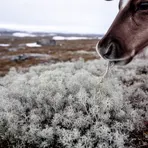
- Specialized
A grey bushy growth like a small plant that covers the tundra and feeds reindeer
Surface Forms
Etymology
Lichen comes from the Greek word leichēn meaning 'a hard patch' or 'lichen', and it may be related to a verb leichein meaning 'to lick'; a helpful image is the plant looking as if it has been 'licked' onto rocks or trees, which explains its patchy, stuck-on appearance.