
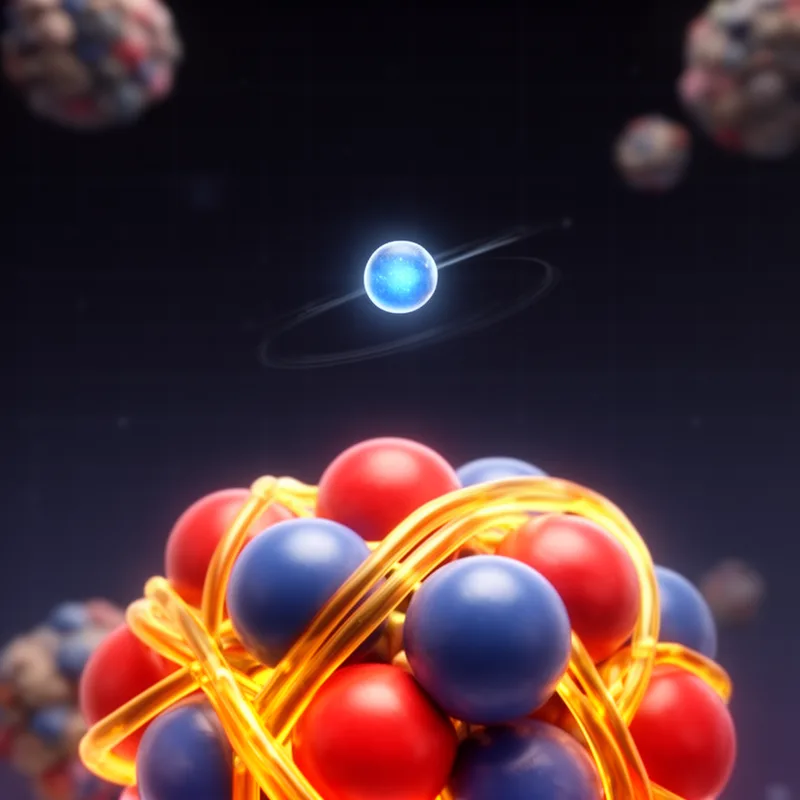
lepton
 2
9.9
2
9.9

- noun
- /ˈlɛp.tɒn/
- Specialized
 :
leptón
:
leptón
- The structure functions should not depend on whether the probing charged leptons are muons or electrons.
- charged leptons
- lepton flavor
- quarks and leptons
These particles come in two families, the family of leptons and the family of hadrons.
- These particles come in two families, the family of leptons and the family of hadrons.
- And, and so the quarks are quarks and the leptons are things like electrons and muons.
- Yes, but we're composed of atoms, and those atoms are composed of quarks and leptons.
- But those can have been broken down into your gluons or leptons, quarks, right?
- You don't get to have sort of the, the, the, the, the Muon case, the Tau lepton case and so on.
Examples
-
In thinking about defining the leptons, it is useful to remember that they are not force-carrying particles.
Academic text (1997) -
These particles come in two families, the family of leptons and the family of hadrons.
-
And the reason is that lepton number is not really thought to be conserved, right?
-
The search for new leptons has expanded in yet other directions.
Academic text (1997) -
Over the course of a century, six leptons have been discovered in the universe of elementary particles.
Academic text (1997) -
These are the quarks, these are the leptons, these are the force carriers.
-
Thus, each of the three known neutrinos is associated with a specific charged lepton (summarized in Table 2).
Academic text (1997) -
And, and so the quarks are quarks and the leptons are things like electrons and muons.
-
We've learned so much from the study of deep inelastic scattering of longitudinally polarized leptons and hadrons.
Academic text (1995) -
In particle physics, a lepton is a type of subatomic particle, such as the electron, that does not engage in strong nuclear interactions.
Synonyms
 59
9.9
59
9.9
A very tiny particle with almost no mass and no electric charge that hardly interacts with matter
 5
9.9
5
9.9
A small particle like an electron but much heavier and lasting only a very short time

A very small particle with a negative electric charge that is part of atoms
A tiny charged particle that lasts about 2 microseconds and becomes an electron and two neutrinos

An extremely small particle with negative charge that lasts about two microseconds and becomes an electron and two neutrinos

A very small particle like an electron but much heavier and lasting a short time
A heavy, short-lived tiny part of matter like an electron but much heavier
A very light particle with no electric charge related to the muon
Surface Forms
Etymology
Lepton comes from the Greek word leptos meaning 'small' or 'thin', and scientists borrowed the name for very small particles like electrons and neutrinos, so the word points to their tiny size.