
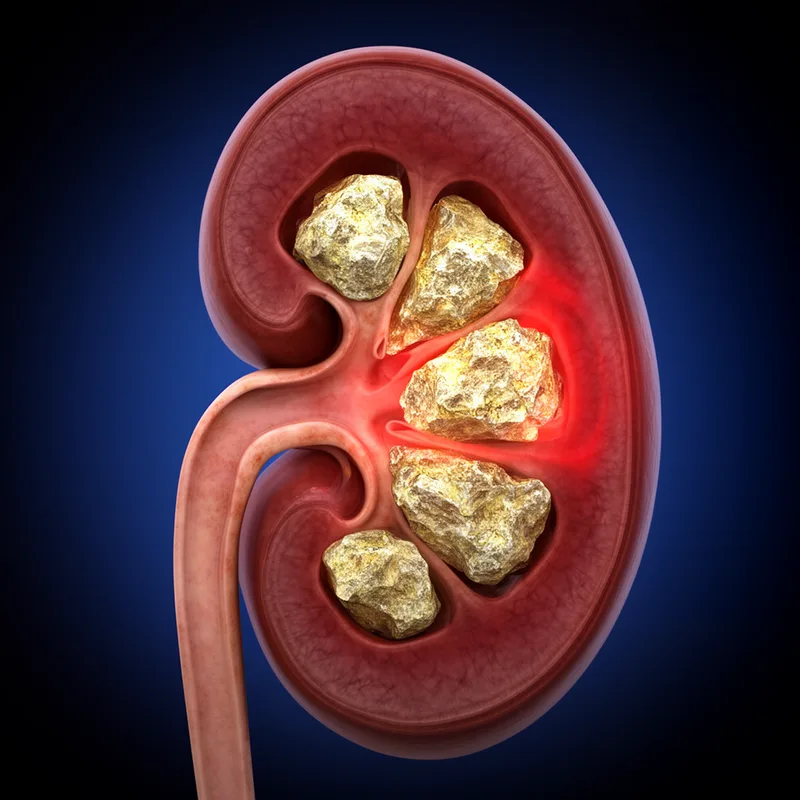
kidney stone
 18
3.7
18
3.7

- noun
- /ˈkɪdni stoʊn/
- Drinking plenty of water can help prevent kidney stones by flushing out minerals.
- passed a kidney stone
- risk of kidney stones
- kidney stone formation
Loading YouTube…
Watch on YouTubeSo now and then I'll reveal that I had a kidney stone, which is common among surgeons.
- So now and then I'll reveal that I had a kidney stone, which is common among surgeons.
- In some cases, excessive intake can lead to hypercalcemia, which leads to kidney stones.
- The stone in question was a kidney stone that it just proudly passed.
- Also a kidney stone and a UTI shoot me in the face.
- If you have ever had a kidney stone, that's a symptom, a sign of perhaps having this condition.
- So that can be kidney cancer, prostate cancer, bladder cancer, sexual health, erectile dysfunction, female sexual dysfunction, kidney stones, children's issues.
Examples
-
I've had six physicians tell me that the kidney stone is the worst kind of pain a man can endure.
-
One of these patients and two additional patients developed kidney stone symptoms.
Academic text (1995) -
I passed a kidney stone.
-
Is it a kidney stone?
-
Well, I have a kidney stone.
-
My husband had a kidney stone about 5 or 6 months ago.
Blog text (12) -
How do you think she got those kidney stones?
-
"David had not been feeling well, and it turned out he was passing a kidney stone," George Lewis said.
Blog text (10) -
And drink more water if you're prone to kidney stone formation.
-
"Once you have a kidney stone, you're at higher risk for developing another kidney stone," says Dr. Moritz.
Blog text (28)
Synonyms
A hard stone that forms in the kidney
A hard stone that forms in the kidney can block the flow of urine
A hard stone that forms in the kidney and can block urine

A hard stone that forms in the bladder or tubes that carry urine
Surface Forms
Morphology
The meaning is directly and compositionally derivable from 'kidney' (an organ that produces urine) + 'stone' (a hard solid mass): a hard mass located in the kidney. This straightforward noun–noun compound is cross-linguistically common in medical vocabulary, so a B1 learner who knows both constituents will very likely infer the intended meaning.
Etymology
Kidney stone comes from a simple picture: a hard stone that forms inside the kidney from minerals. These small, hard pieces can block the tubes that carry urine and cause strong pain, so the name means 'a hard, solid mass in the kidney that causes pain'.