

jawless vertebrate
- noun
- /ˈdʒɔːləs ˈvɜːrtəbrɪt/
- Specialized
- Lampreys are a common example of a living jawless vertebrate found in freshwater streams.
Examples
-
Unlike most fish, a jawless vertebrate does not have paired fins or true jaws.
-
The fossil record shows that several types of jawless vertebrates existed hundreds of millions of years ago.
-
Lampreys are a common example of a living jawless vertebrate found in freshwater streams.
-
The jawless vertebrate is a fascinating creature.
-
Many jawless vertebrates inhabit the ocean depths.
-
The fossil record shows that several types of jawless vertebrates existed hundreds of millions of years ago.
-
Unlike most fish, a jawless vertebrate does not have paired fins or true jaws.
Synonyms

A group of eel-shaped animals without jaws, like lampreys and hagfish
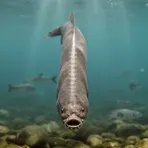
A fish-like animal with a backbone and no jaws or paired fins, like lampreys
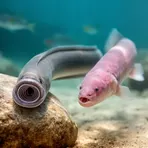
Fish like lampreys and hagfish that do not have jaws or paired fins

A group of simple jawless water animals like lampreys and hagfish

A jawless animal that lives in water, like a lamprey or hagfish
Surface Forms
Morphology
The meaning is directly compositional: 'jawless' (without jaws) modifies 'vertebrate' (a backboned animal), so a B1 learner who knows both constituents can easily infer 'a vertebrate without jaws.' This adjective+noun pattern is a regular, cross-linguistically common construction, making the expression transparently interpretable.
Etymology
Jawless vertebrate is a name that gives a simple picture: jawless means 'no jaws' and vertebrate means an animal with a 'backbone'. Think of lampreys or hagfish, long eel-like animals with round, sucking mouths. That's why the term means an eel-shaped animal with a backbone but without jaws or paired fins.

