
inversion
 1
8.1
1
8.1

- noun
- /ɪnˈvɜrʒən/
- Specialized
- Learning about inversions is essential for understanding how to create varied melodies in composition.
- a chord inversion
- first inversion
Loading YouTube…
Watch on YouTubeThen your next set is this one where you're doing the second inversion diatonic chords.
- Then your next set is this one where you're doing the second inversion diatonic chords.
- So you get your second version, first inversion F# major, second inversion F major.
Examples
-
Ear training includes simple harmonic progression identification as well as interval and chord inversions.
Academic text (2009) -
Our point was to let you know that with 7th chords, there are only 4 inversions.
Blog text (12) -
And the last inversion is F# GAD.
-
Then your next set is this one where you're doing the second inversion diatonic chords.
-
Explain that the movement between the tones in each voice part should be minimal, hence the need for chord inversions.
Academic text (1997) -
The AP course will cover material ranging from root progressions to supertonic sevenths and their inversions.
Academic text (1993) -
Voice leading is better in this two-chord progression when the dominant chord is in first inversion (V6): the upper voice sustains the tone, the middle voice sings mi-re, and the lower voice sings do-tit.
Academic text (1997) -
In the AP music exam, there are usually two harmonic dictation exercises, which are major and minor settings of about ten chords in root, first, or second inversion with ii7 and V7 chords in first, second, or third inversions.
Academic text (1993) -
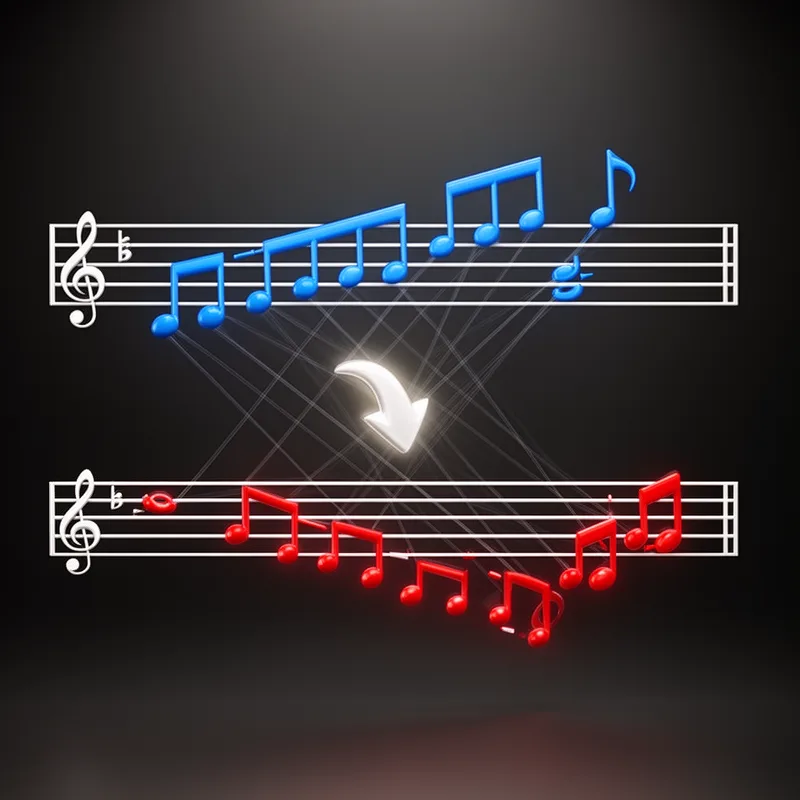
In music theory, an inversion occurs when the notes of a chord are rearranged, so that the lowest note is no longer the root.
-
The song features several chord inversions, making it more interesting harmonically and easier to play.
Synonyms
 25
4.2
25
4.2
A change to the opposite direction or position, for example when wind turns
 8
6.2
8
6.2
Something that is the opposite of another thing in order or effect
Compounds

- Specialized
To find a matrix that, when multiplied by the original, makes the identity matrix

Surface Forms
Morphology
Etymology
Inversion comes from the Latin invertere, where in- means 'in' and vertere means 'to turn'. In music, an inversion is a melody 'turned the other way', so upward moves become downward and vice versa.