
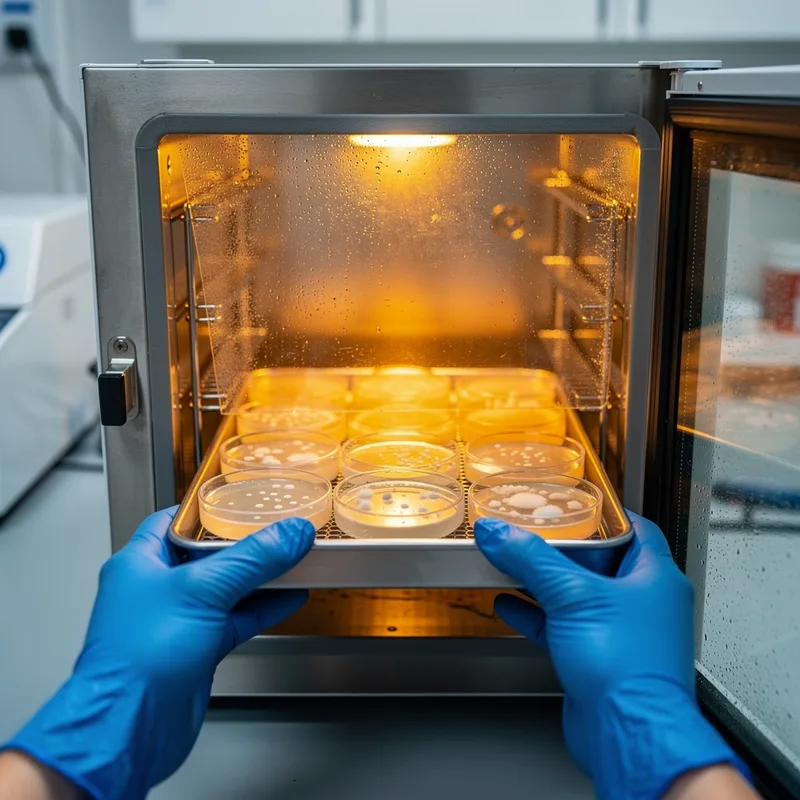
to incubate
 5
7.2
5
7.2

- verb
- /ˈɪŋkjʊˌbeɪt/
- Specialized
- The swab was then streaked directly onto MacConkey's agar and incubated at 37°C for 24 hours.
- plates were incubated
- incubated for 24 hours
- samples were incubated
Loading YouTube…
Watch on YouTubeImmunocompromised age aids patients have also been suspected to potentially incubate more variants.
- Immunocompromised age aids patients have also been suspected to potentially incubate more variants.
- Then we take stem cells from the patients and we incubate them with the beta globin gene, which is in the school bus.
Examples
-
Then they incubate the flask for a day and then plate them out again.
-
Afterward, 125 mM glycine was added and incubated for 5 minutes.
Academic text (2017) -
I need this to incubate for 24 hours.
-
OK, So you incubate, you let let it wait for a while, then you wash.
-
The plates then were incubated at room temperature for 24 hours to activate the cultures.
Academic text (1993) -
Then the mixture was shaken by hand and incubated in a boiling water bath for 15 minutes.
Academic text (2013) -
Mineral oil was added to each tube, and then the tubes were incubated at 32 degrees C for 48 hours.
Academic text (1993) -
The coliform analyses were done using the membrane filter method with m-Endo broth and incubated for 24 hours.
Academic text (1998) -
Total bacteria colonies were detected on nutrient agar plates incubated for 48 hours at 30°C.
Academic text (2006) -
The scientist will incubate the culture at a constant temperature for optimal growth.
Synonyms
To keep bacteria or cells at a set warm temperature so they grow
Antonyms


Phrasal Verbs

Compounds
- Specialized
To keep bacteria or cells at a set warm temperature so they grow
How Supported

Surface Forms
Morphology
incubate = incub + ate
The verb is formed from a non-productive combining form plus the Latinate verb-forming suffix '-ate'; these components are not recognizable as independent English words for an average B1 learner, so the meaning cannot be reliably deduced from parts.
Etymology
Incubate comes from the Latin parts in- 'on' and cubare 'to lie', because people once 'lay on' eggs to keep them warm. So in science, to incubate something means to keep it in the right warm conditions so it can develop and grow.