
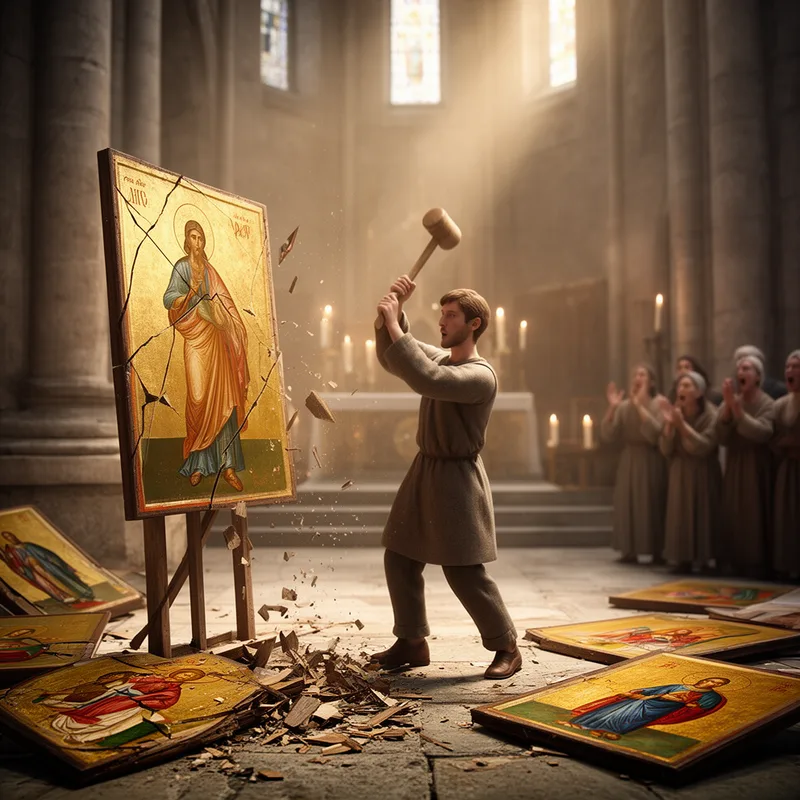
iconoclast
- noun
- /ˈaɪkəˌnɔːklæst/
- Formal
- It is equally possible that the upper parts of the faces were deliberately mutilated, reflecting the activities of medieval iconoclasts, for whom the face would have been an obvious target.
- Muslim iconoclasts
- medieval iconoclasts
Examples
-
Equally, the effacement (or, more correctly, defacement) of the image and the particular focus on the eyes are consistently evident in the work of Muslim iconoclasts from the early Islamic period on (Fig. 7), although by no means exclusive to them.
Academic text (2002) -
The ambiguities arising from the dual status of the image are reflected in the practices of Muslim iconoclasts in South Asia (and undoubtedly elsewhere), a point well made by Andr Wink:
Academic text (2002) -
Freedberg has pointed out that iconoclasts seeking publicity target art objects precisely because
Academic text (2002) -
Scholars, notably Cyril Mango in 1959, have argued that the Chalkites was a painted panel because the iconoclasts sent it to the fire.
Academic text (2006) -
In later paintings, the Prophet is sometimes (but not always) portrayed with his face veiled or otherwise obscured; this reticence about the face finds a counterpart in the activities of medieval iconoclasts in the Islamic world, as we shall see below.
Academic text (2002) -
The history books are filled with stories of the iconoclast who destroyed many religious statues.
-
As an iconoclast, she was known for challenging traditional beliefs and tearing down cultural icons.
-
During the Reformation, many iconoclasts vandalized churches to eliminate images they considered idolatrous.
Synonyms
A person who destroys religious pictures or statues
Antonyms

How Destructive


Surface Forms
Morphology
Etymology
Iconoclast comes from Greek parts icon meaning 'image' and -clast meaning 'breaker'. In history it referred to people who destroyed images used in religious worship, which is why this sense means a person who destroys religious pictures.