
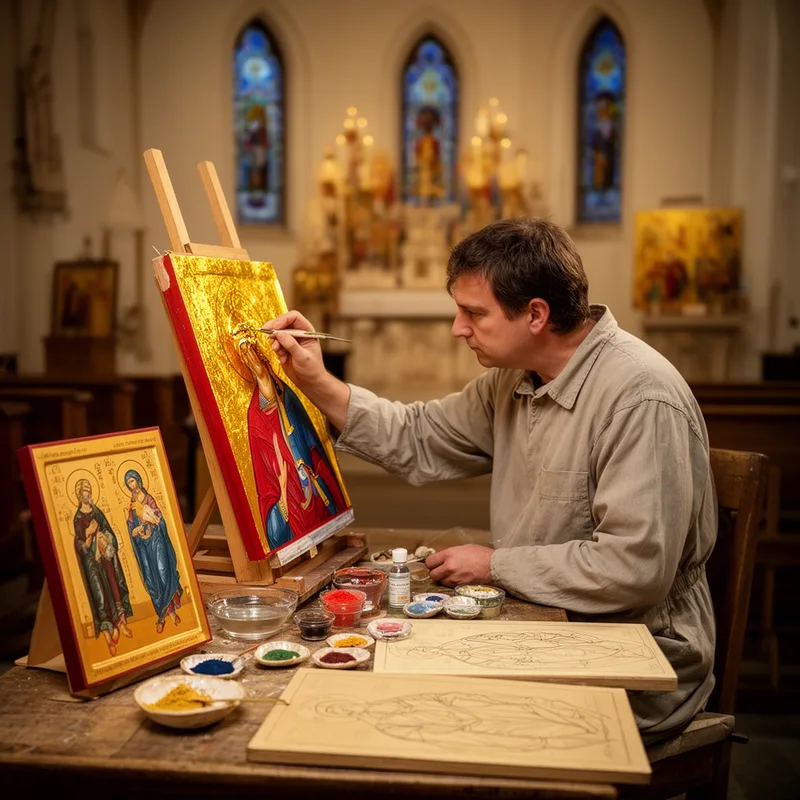
iconographer
- noun
- /ˌaɪkəˈnɒɡrəfə/
- Specialized
- The iconographer spent years perfecting the technique used to create stunning religious images.
Examples
-
Iconographers such as Andor Pigler have documented the death of Socrates as a subject roughly from the mid-sixteenth to the mid-nineteenth centuries.
Academic text (1995) -
However, over the centuries it has posed many problems to the iconographer (Fig. 1).
Academic text (1995) -
Later medieval iconographers make a similar point but in a pictorial medium.
Academic text (2000) -
Through the 1980s, the hundreds of rollouts and thousands of pictures in the Kerrs' files helped another wave of young epigraphers and iconographers make more discoveries.
Academic text (2003) -
Meanwhile, William Saturno and iconographer Karl Taube were arguing that the San Bartolo murals depicted the Olmec maize god.
Academic text (2007) -
From connoisseurs to iconographers to social historians, the quest for clarity within the shadowy realms of origins, meanings, and contexts has long been of compulsive importance.
Academic text (2002) -
During the workshop, the iconographer taught participants how to depict saints on wooden panels.
-
Many art historians study the works of famous iconographers to understand the evolution of Christian art.
Antonyms


Surface Forms
Morphology
iconographer = iconography (semi-transparent) = icon + graphy + er
The noun is regularly formed from iconography with the agentive suffix -er, so the derivation is straightforward once the base term is known.
Etymology
Iconographer comes from the Greek parts icon ('image') and -graph ('to write' or 'to draw'), the same -graph you see in photographer. So an iconographer is someone who creates or studies painted religious images.