
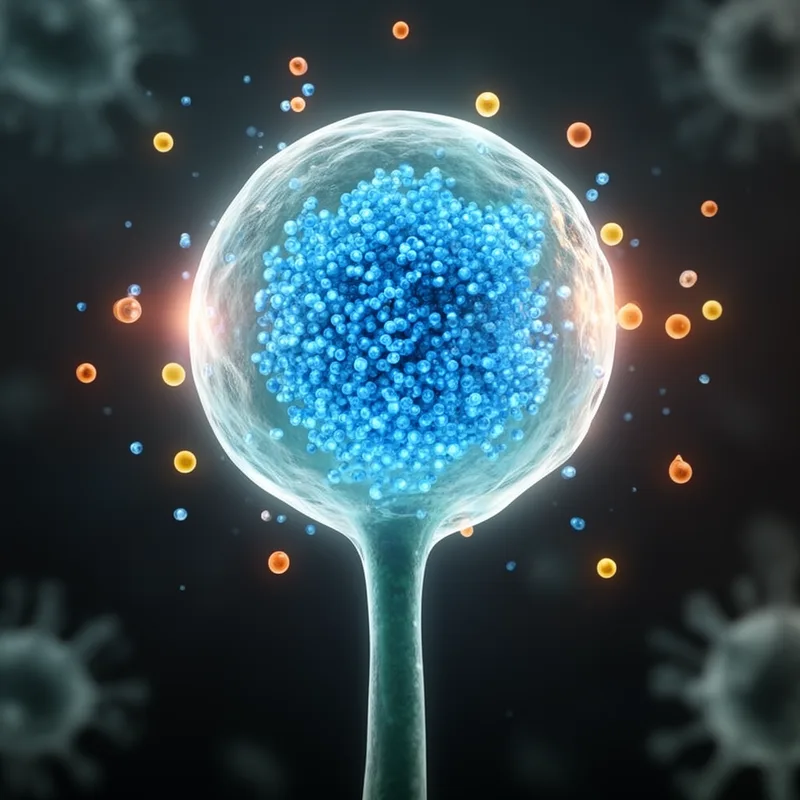
hyperpolarization
- noun
- /ˌhaɪpərˌpoʊlərɪˈzeɪʃən/
- Specialized
- In neurons, hyperpolarization increases the negative charge inside the cell, making it less likely to fire an action potential.
Examples
-
Initial studies have highlighted the role of endothelial KIR channel-induced hyperpolarization at the capillary level and of neuronal NO in arterioles, but how these responses are generated, transmitted, and appropriately timed requires further study.
Academic text (2017) -
OK, so now let's say it causes hyperpolarization of the membrane.
-
Depolarization or hyperpolarization of the membrane can be thought of as special cases of second messenger signaling.
Academic text (2017) -
The opening of TMEM16B-CaCC, in turn, triggers the hyperpolarization to shut down the CaV channels.
Academic text (2017) -
In the brain, KATP channel activation in the neuronal cells led to hyperpolarization and reduced excitability, increasing the risk of the neurons' silence 55.
Academic text (2018) -
It can mediate the hyperpolarization of the postsynaptic membrane, induce ion influx, and decrease cell metabolism and oxygen consumption.
Academic text (2015) -
Increased durations from clonidine and dexamethasone are postulated to be the results of hyperpolarization of cyclic nucleotide-gated channels and inhibition of nociceptive.
Academic text (2018) -
The hyperpolarization of the membrane helps regulate the flow of ions, maintaining a stable equilibrium in the cell.
-
When the potassium channels open, they cause hyperpolarization, which reduces the cell's excitability and helps maintain resting state.
How Polarized
- Specialized

- Specialized
- Specialized
 1
8.1
1
8.1

Surface Forms
Morphology
hyperpolarization = polarization (semi-transparent) = hyper + polar + ization
The form clearly means 'more polarization', but the physiological sense is technical and not fully predictable for a general learner.
Etymology
Hyperpolarization starts with hyper- meaning 'over' or 'too much' and uses polar meaning 'pole' or 'two ends'. In a cell this means the inside becomes more negative than usual, so the cell's electrical 'poles' are made stronger and the neuron is less likely to fire.