
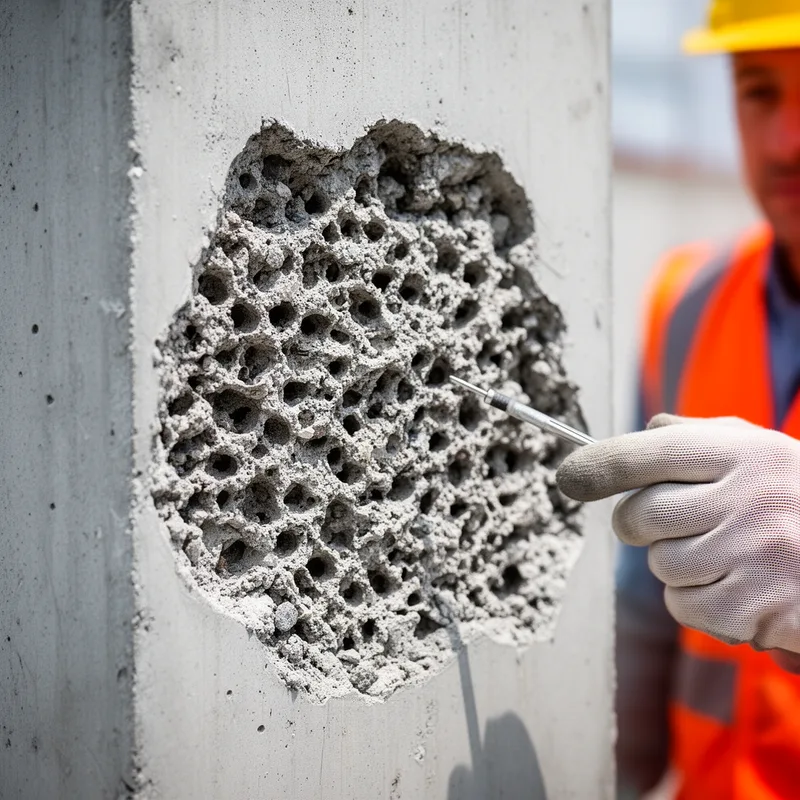
honeycombing
7.2
Many small holes in a material like concrete or wood that make it weak
- noun
- /ˈhʌniˌkoʊmɪŋ/
- Specialized
:
honeycombing
- Patients with reticular abnormality in a subpleural, basal predominance, but without honeycombing, are considered to have a possible usual interstitial pneumonia pattern.
Examples
-
The old building displayed signs of honeycombing, indicating deterioration in its foundation.
-
The engineer explained that the honeycombing of the concrete could weaken the structure over time.
-
In tissue samples, honeycombing can signify underlying damage that needs further examination.
Antonyms



solidification
- Specialized
 1
6.8
1
6.8
The change when a liquid or soft thing becomes hard, usually by cooling
How Perforated

Surface Forms
honeycombing singular
honeycombing plural
Morphology
Etymology
Honeycombing comes from the words honey and comb, with comb meaning 'the many small cells in a beehive'. The word is used when a material has lots of small holes or cavities like a beehive, which can make concrete, wood, or walls weak, so builders and engineers call that pattern honeycombing.