
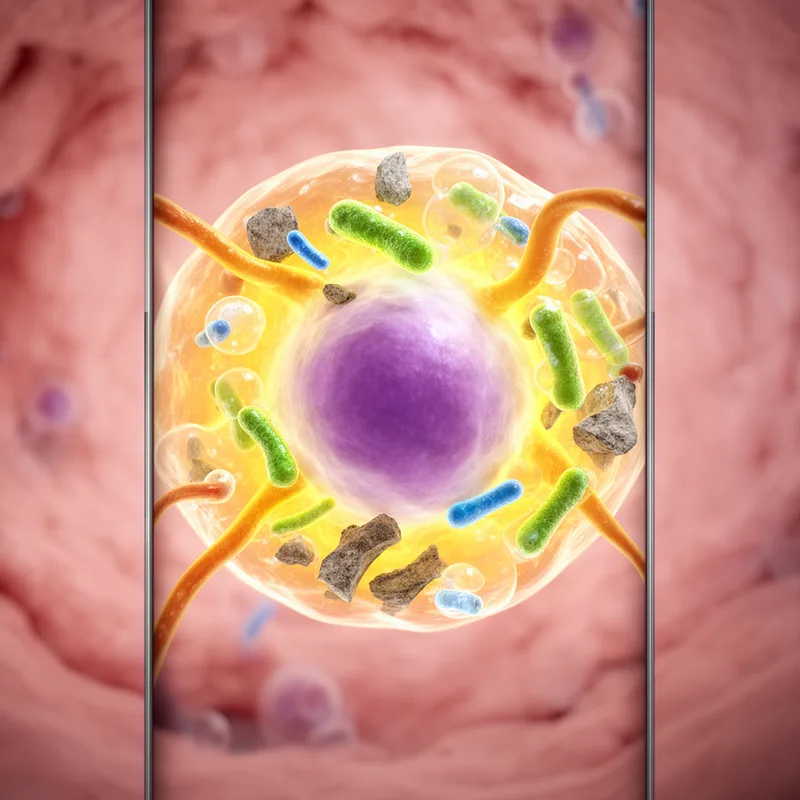
histiocyte
- noun
- /ˈhɪstəˌsaɪt/
- Specialized
 :
histiocito
:
histiocito
- The histiocytes in the tissue sample indicated an active immune response to the infection.
- histiocytes and plasma cells
- histiocytes and eosinophils
- histiocytes and lymphocytes
Examples
-
Much less frequently, micro-organisms have been identified within histiocytes in the lesion.
Academic text (2003) -
Some of the histiocytes displayed emperiopolesis (engulfment) of lymphocytes (Figure 4).
Academic text (1998) -
In microscopic section, we may expect evidence... ...of fatty degeneration in cells... ...with polymorphs and histiocytes around them.
-
In such cases, the histiocytes are mixed with eosinophils, lymphocytes, plasma cells, and neutrophils.
Academic text (2002) -
In addition, multinucleated, histiocyte-like cells were found interspersed between the spindle cells (figure 2).
Academic text (2001) -
Histology will reveal the presence of histiocytes, eosinophils, plasma cells, lymphocytes, and neutrophils.
Academic text (2002) -
The hallmark finding is a mixed inflammatory reaction including neutrophils, eosinophils, lymphocytes, and histiocytes.
Academic text (2009) -
An acute infiltrate consisting of lymphocytes, histiocytes, neutrophils, and eosinophils may be found around superficial and deep blood vessels.
Academic text (2007) -
Immunohistochemical analysis demonstrates that the histiocytes display a strongly positive reaction to S-100, OKT6, CD4, CD68, and factor XIIIa.
Academic text (1998) -
Pathologic examination revealed skin with a dense dermal infiltrate consisting of histiocytes in a sinusoidal pattern surrounded by plasma cells and lymphocytes (Figure 3).
Academic text (1998)
Synonyms
 7
6.7
7
6.7

A large white blood cell that eats and removes germs and dead cells
 3
5.4
3
5.4
A white blood cell that helps the body fight infection by eating bacteria and fungi

 1
8.1
1
8.1
A cell that eats and destroys bacteria and dead cells to help the body's immune system
 1
5.8
1
5.8
A tiny part of the body that eats dead tissue and germs to help fight infection
Surface Forms
Morphology
histiocyte = histi + cyte
Formed from specialized combining forms 'histi-' (tissue) and '-cyte' (cell) that are not standalone English words, so an average B1 learner cannot derive the meaning from the parts.
Etymology
Histiocyte comes from Greek parts histio- meaning 'tissue' and -cyte meaning 'cell'. So a histiocyte is literally a 'tissue cell' that lives in body tissue and helps clean up debris and fight infection.