
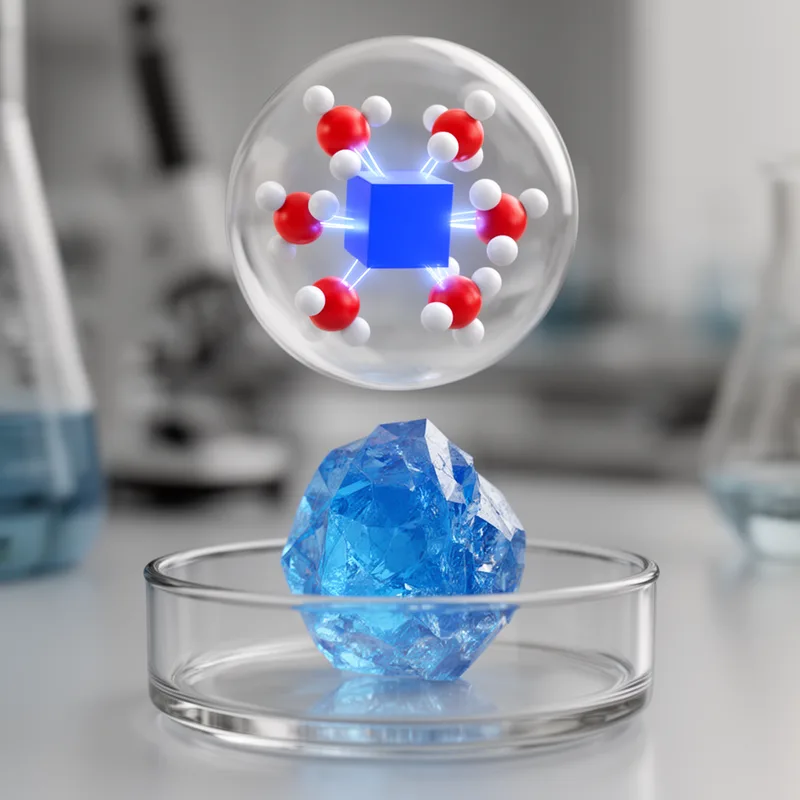
hexahydrate
9.5
Containing six water molecules in each crystal
- adjective
- /ˌhɛksəˈhaɪdreɪt/
- Specialized
:
hexahidratado
- The label indicated that the chemical was in its hexahydrate form, not the anhydrous form.
Examples
-
The label indicated that the chemical is available in hexahydrate form for better solubility.
-
The copper(II) sulfate hexahydrate crystals are bright blue due to the water molecules.
-
When heated, the hexahydrate loses its water and turns into an anhydrous compound.
-
The compound is a hexahydrate of copper sulfate.
-
Sodium sulfate can form a hexahydrate under certain conditions.
-
The copper(II) sulfate hexahydrate crystals are bright blue due to the water molecules.
-
When heated, the hexahydrate loses its water molecules and becomes an anhydrous compound.
How Hydrated
hexahydrate
- Specialized

pentahydrate

 1
9.0
- Specialized

 1
9.0
trihydrate
- Specialized
monohydrate
1
7.9
- Specialized
1
7.9
anhydrous
3
9.8
- Specialized
3
9.8
Surface Forms
hexahydrate positive
Morphology
Etymology
Hexahydrate is made of hexa- 'six', like in hexagon, and hydrate 'water', like in to hydrate. So hexahydrate describes something that has six water molecules attached.