
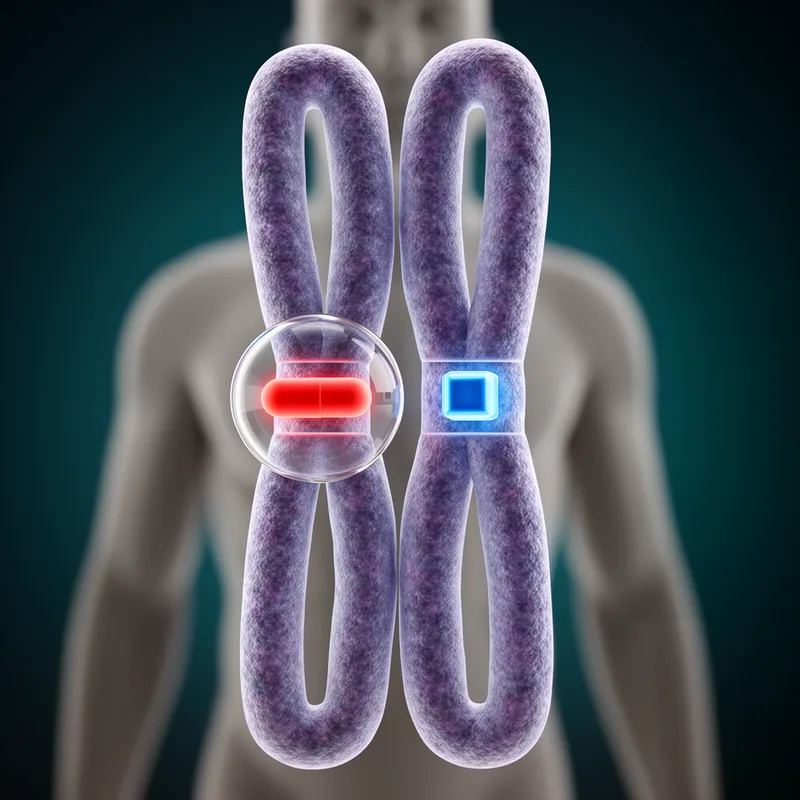
heterozygosity


 1
9.9
- noun
- /ˌhɛtəroʊzaɪˈɡɒsɪti/
- Specialized
- In a population of plants, a high level of heterozygosity can increase resilience against diseases.
- high heterozygosity
- observed heterozygosity
- heterozygosity levels
Examples
-
The investigators report that heterozygosity for the IL12B promoter polymorphism is associated with increased severity of asthma in childhood.
Academic text (2002) -
One, SM7, is especially informative; we have found fourteen alleles, and the observed heterozygosity in Caucasians is 62.7%.
Academic text (1991) -
And so this is another way that you can lose heterozygosity as you have repression of transcription.
-
Genetic distance indices can be used in a similar fashion, and comparisons of heterozygosity levels may also be informative in some cases.
Academic text (1991) -
Results showed that the population conformed to Hardy-Weinberg equilibrium and that the locus had an observed heterozygosity of 0.944.
Academic text (2007) -
For each locus and site, we calculated the number of alleles, expected (He) and observed (Ho) heterozygosity, using Arlequin.
Academic text (2018) -
The overdominance hypothesis (East 1908) argues that heterozygosity confers properties that are superior to either homozygote.
Academic text (2010) -
We have found eleven SM7 alleles among the Caucasian population studied; the observed heterozygosity is 62.7%, and the calculated polymorphism information content is 0.63.
Academic text (1991) -
Populations that have suffered a bottleneck are expected to show excess heterozygosity in comparison to the expected number under mutation-drift equilibrium (Piry et al., 1999). Results Mitochondrial data.
Academic text (2018) -
Ultimately, the N estimate is determined by comparing the observed data to the simulated data for a series of statistics relating genetic variation to N e, including expected heterozygosity, number of alleles per locus, mean and variance of multilocus homozygosity, and others.
Academic text (2009)
Antonyms
- Specialized
1
9.9
The state of having two identical copies of a gene, one from each parent
How Heterozygous
- Specialized
1
9.9

- Specialized
1
9.9
Surface Forms
Morphology
heterozygosity = heterozygous (semi-transparent) = hetero + zygote + ity
The noun is formed by regular suffixation (-ity) from the adjective 'heterozygous', a standard and predictable derivation.
Etymology
Heterozygosity comes from the parts hetero- 'different' and zygo- 'yoke', where a 'yoke' is something that joins two things. So heterozygosity is the state of having two different 'gene versions' at the same spot, which is why it means having two different 'alleles'.