
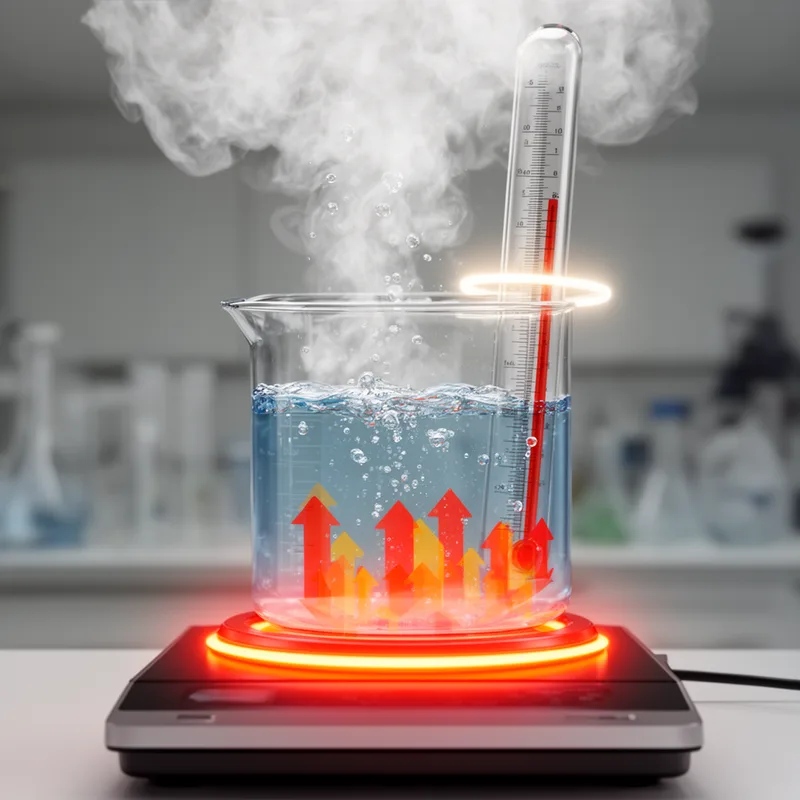
heat of vaporization
- noun
- /hiːt əv ˌveɪpəraɪˈzeɪʃən/
- Specialized
- They seemed quite excited about having worked with liquid nitrogen (whose heat of vaporization they were asked to measure); they thought the substance was "neat."
Examples
-
Volumetric capacity is dependent not only on the latent heat of vaporization but also on the density of the refrigerant vapor that enters the compressor.
Academic text (1998) -
The high heat of vaporization helps explain why sweating cools the body more effectively.
-
The heat of vaporization and the heat of fusion are two very big numbers multiplied by all that ice.
Blog text (28) -
Similarly, it takes a lot of energy to increase the temperature a small amount when the fluid is near the critical point, much like the heat of vaporization requires energy to convert a liquid to a vapor.
Academic text (2012) -
Compound vapor pressures and associated heats of vaporization strongly influence removal efficiencies 43.
Academic text (2018) -
None of the latent heat of vaporization of steam generated in the HRSG is lost to the cycle, so the potential exists for efficient exhaust energy recuperation.
Academic text (1995) -
The heat of vaporization of water is necessary for processes such as boiling and evaporation.
-
Understanding the heat of vaporization is important for thermal dynamics in engineering.
Synonyms
 1
5.0
1
5.0

Heat taken in or given out when a material changes state, such as melting and boiling
Surface Forms
Morphology
heat + of + vaporization
The phrase is a straightforward compositional noun phrase: 'heat' (energy) related to the process named by 'vaporization' (turning a liquid into vapor), so the meaning ‘the heat associated with vaporization’ is directly derivable from the parts. It follows a regular English 'X of Y' technical naming pattern that is cross‑linguistically common, so a learner who knows the constituents would understand the term.
Etymology
Heat of vaporization comes from its literal parts: heat (the energy you give) and vaporization (the act of turning a liquid into a gas). Think of boiling water: you keep adding heat but the temperature stays the same until the water becomes gas. So, the phrase means the exact amount of heat needed to 'vaporize' a liquid.