

hard coal
- noun
- /hɑrd koʊl/
- Specialized
- The city council decided to promote the use of hard coal as a cleaner energy source for heating.
Examples
-
Many homes were heated with hard coal during the winter months due to its efficiency.
-
This degree of detail permits analysts to address fairly specific questions (such as the change in emissions that would result if Germany's electric utilities were to use more hard coal instead of soft coal) as well as more broadly based ones.
Academic text (1999) -
Like most power plants in Germany, BoA burns lignite, a soft coal that's sourced from domestic open-cast strip mines and emits about 29 percent more carbon dioxide than hard coal when burned.
Blog text (28) -
The factory switched to using hard coal because it produces more heat for less money.
Synonyms

 1
9.8
1
9.8

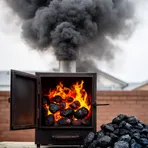
A hard, natural coal that burns slowly with little smoke and gives a lot of heat

A hard, shiny coal that burns slowly and makes a lot of heat with little smoke
Antonyms
How Hard


Surface Forms
Morphology
The phrase is a straightforward adjective + noun compound where 'hard' modifies 'coal' to indicate a firmer, denser type of coal. A B1 learner who knows both words can readily infer it denotes a particular variety of coal with the described burning properties; this compositional pattern is cross-linguistically common and non-idiomatic.
Etymology
Hard coal comes from the simple image of very solid coal: the word hard describes the firm, dense rock and coal is the fuel. People noticed this coal was tougher and gives strong heat when burned, so hard coal came to mean 'a type of coal that burns slowly and produces strong heat'.