
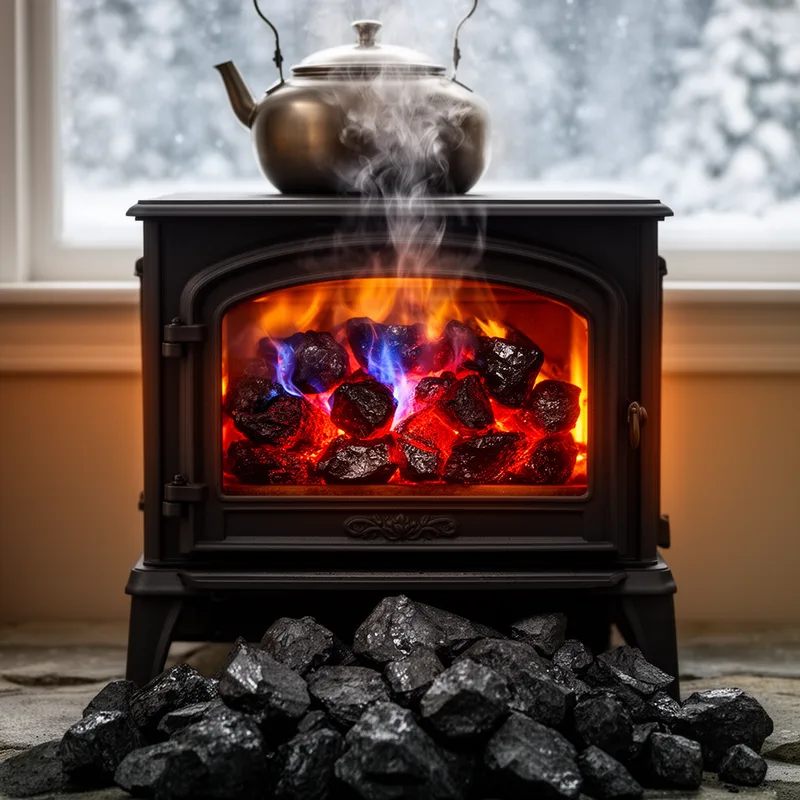
anthracite
 1
9.8
1
9.8

- noun
- /ˈænθrəˌsaɪt/
- A large supply of anthracite is essential for maintaining efficient heating during winter.
- anthracite region
Examples
-
Many more settled in the coal and anthracite mining counties of central Pennsylvania and northern Illinois.
Academic text (1990) -
That prediction assumes equal use of all grades of coal, from anthracite to lignite.
Academic text (2004) -
Anthracite makes the best fire.
-
Those mountains are full of high-grade anthracite.
-
Keep an eye out, and you'll see veins of anthracite layered in with the rock.
Blog text (29) -
Experts estimate that roughly 54% of the reserve underground—comprising anthracite, bituminous, subbituminous, and lignite rock—is recoverable.
Academic text (2004) -
We used anthracite in the furnace because it burns slowly and produces a lot of heat.
-
The mine primarily produces anthracite due to its high quality and low smoke emissions.
Synonyms

A hard, shiny coal that burns slowly and makes a lot of heat with little smoke

A hard natural fuel that burns slowly and gives very strong heat
Compounds
How Hard
1
9.8

- Specialized

 1
6.6
1
6.6
- Specialized
- Specialized
1
8.7
Surface Forms
Morphology
anthracite = anthrac + ite
The element 'anthrac-' is a Greek combining form (not a standalone English word) and '-ite' is a mineral-forming suffix; knowing common English words does not allow a learner to infer the meaning of 'anthracite'.
Etymology
The word anthracite comes from the Greek word anthrax meaning 'coal' or 'charcoal', and the ending -ite was later used to name types of rocks. So, anthracite is literally a 'coal rock', a hard, high-grade coal that burns slowly with little smoke.