

green ash
- noun
- /ɡrin æʃ/
- US
- Current hydrological conditions favor regeneration only for green ash (Yin et al., 2009a) and invasion by Phalaris, the spread of which further challenges tree seedling establishment and growth.
- green ash, red maple
- green ash and eastern cottonwood
- green ash and American elm
Examples
-
Unfortunately, the long-term persistence of green ash, the second most important tree in this forest, is threatened by the emerald ash borer.
-
In the permanent forest, they planted tulip poplars, green ash, and swamp black gum; then they let native plant species establish among the trees over time.
Academic text (2003) -
Through the window, they could see him saying his farewell to Grimald, where the boy was cutting splints of green ash.
Fiction book (1993) -
Additional riparian species common in the Coastal Plain and found along stream valleys to the west include green ash and eastern cottonwood.
Academic text (2012) -
Unfortunately, the long-term persistence of green ash, the second most important tree in this forest, is threatened by the emerald ash borer.
Academic text (2016) -
Eastern cottonwood is common on sandy sites, whereas green ash grows best on finer, more fertile soils.
Academic text (2012) -
Ash loss will reduce overall forest cover, and some bird species may prefer to nest in ash (we found several Blue-gray Gnatcatcher nests in green ash).
Academic text (2016) -
A majestic green ash anchors one end of the long path through the border garden.
-
In the permanent forest, they planted tulip poplars, green ash, and swamp black gum; then they let native plant species establish among the trees over time.
Synonyms
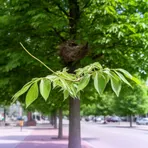
A North American ash tree with soft young branches and leaves that are fuzzy underneath, often called green ash
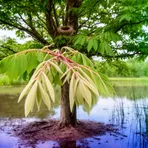
A North American tree with soft young branches and lower leaf surfaces often found in wet areas
Surface Forms
Morphology
The compound follows a straightforward adjective + noun pattern where 'green' describes a subtype of 'ash' (the tree), so the meaning as a particular kind of ash tree is directly derivable from its parts. This compositional pattern is cross-linguistically common and would be immediately comprehensible to a B1 learner who knows both constituent words.
Etymology
Green ash comes from the simple picture of an ash tree with bright green leaves and a lighter colour under each leaf, which made it easy for people to tell this kind of tree apart. So the name simply means this particular kind of 'tree'.

