
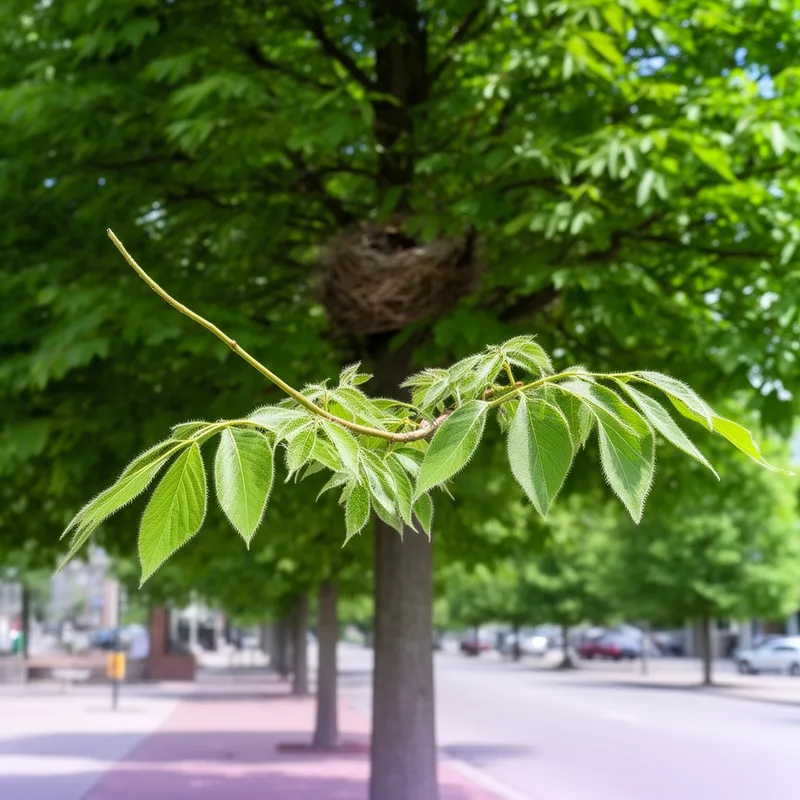
Fraxinus pennsylvanica
- noun
- /ˈfræk.sɪ.nəs ˌpɛn.sɪlˈvæ.nɪ.kə/
- Specialized
- The Fraxinus pennsylvanica is widely planted along city streets for its shade and resilience.
Examples
-
The Fraxinus pennsylvanica, commonly known as green ash, thrives in the humid conditions of the Midwest.
-
Researchers studied the effects of disease on local populations of Fraxinus pennsylvanica trees.
-
Many birds nest in the branches of the Fraxinus pennsylvanica found across the Midwest.
-
The Fraxinus pennsylvanica is often found in wetland areas.
-
Many parks in the Midwest feature the Fraxinus pennsylvanica tree.
-
Due to its adaptability, the Fraxinus pennsylvanica is often used in landscaping for shade in urban environments.
-
In spring, the Fraxinus pennsylvanica showcases delicate green leaves that later turn vibrant in autumn.
Synonyms
A North American tree with soft young branches and lower leaf surfaces often found in wet areas
A North American ash tree with lighter colour under its leaves
Surface Forms
Morphology
Fraxinus + pennsylvanica
This is a standard Latin binomial: the genus name 'Fraxinus' (ash) combined with a specific epithet 'pennsylvanica' (indicating origin), so a learner who knows both constituents can infer it denotes a species of ash, likely associated with Pennsylvania. Biological naming conventions are cross-linguistically consistent, so the species meaning is compositionally derivable from the parts.
Etymology
Fraxinus pennsylvanica is a Latin name with two parts: Fraxinus is the Latin word for 'ash', and pennsylvanica means 'from Pennsylvania'. So the name simply describes this ash tree as one found in that region, which is why we call it the green ash today.

