
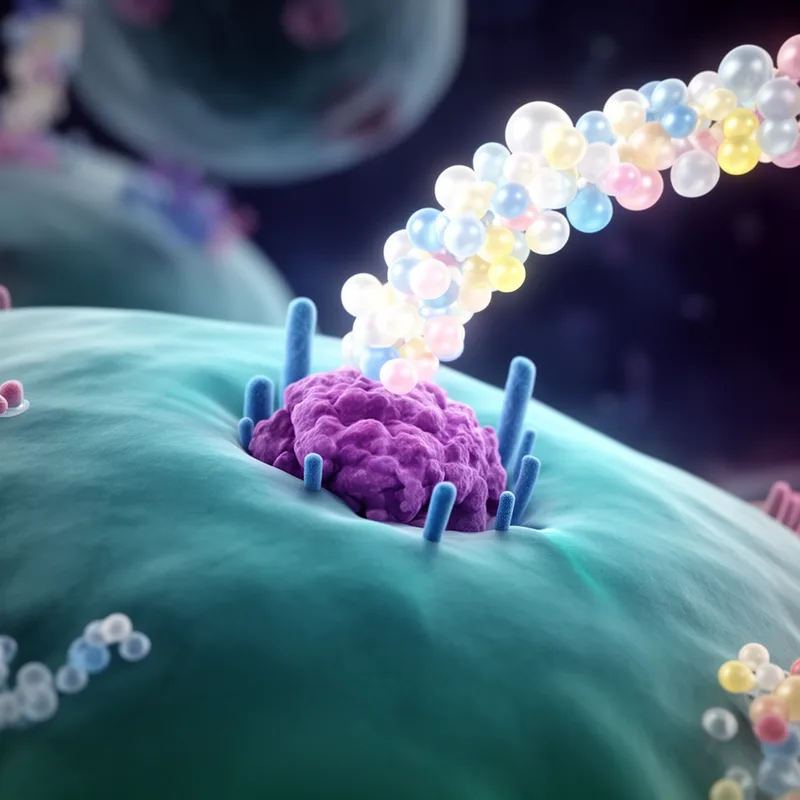
glycan
- noun
- /ˈɡlaɪkən/
- Specialized
- Furthermore, cancer-associated glycans are often shed into the bloodstream and can potentially be used for non-invasive detection 143,144.
- O-glycans
- N-glycan
- glycan chain
Examples
-
Glycans are crucial for cell communication and are often found on the surface of glycans.
-
The antibiotic's effectiveness can be influenced by the types of glycans present on bacterial surfaces.
-
Clearly, this will make the formulation of an effective glycan-based vaccine difficult, if not impossible.
Academic text (2018) -
So often the glycans there serve as decoys to make the human body think, well there's nothing wrong here.
-
Bacterial carbohydrates, also known as glycans, provide an interface between a pathogen and its environment.
Academic text (2018) -
Combining molecular information from glycan and peptide moieties holds tremendous potential for designing highly specific targeted therapeutics.
Academic text (2016) -
Exploring the cell-surface nature of cancer-associated glycans may provide the necessary means to selectively deliver anti-cancer nanodrugs to tumor cells.
Academic text (2016) -
In addition, many of the proteins carrying cancer-associated glycans may also be shed into the bloodstream or other bodily fluids, facilitating non-invasive detection methods.
Academic text (2016) -
Researchers study glycans to understand their role in diseases like cancer.
Synonyms

 82
3.6
82
3.6

A nutrient in foods like rice and bread that gives the body energy
 2
7.0
2
7.0
Sugar units join together to form a long chain used for energy or structure in cells
A small carbohydrate made of a few simple sugars linked together

A substance like sugar or starch that gives living things energy and helps form parts of cells
How Complex
- Specialized
2
7.0

- Specialized
- Specialized
- Specialized

 1
8.2
1
8.2
- Specialized
1
6.8
Surface Forms
Morphology
glycan = glyco (opaque) = glyc + an
The term 'glycan' is specialized and not directly transparent from its parts without specific biochemical knowledge.
Etymology
The word glycan comes from the Greek root glyc- meaning 'sweet', like 'sugar', and the ending -an for a substance, so a glycan is a molecule made of sugar parts, a chain of sugars often found on cells and proteins.