

glass lizard


 1
9.2
1
9.2
- noun
- /ɡlæs ˈlɪzərd/
- Specialized
- Unlike snakes, glass lizards have eyelids and ears, so it's easy to tell them apart.
Examples
-
Did you see a glass lizard in the garden?
-
Long-tailed surface dwellers, glass lizards have fragile tails that can break off if grabbed by a predator.
-
If a predator grabs its tail, a glass lizard can break it off and escape.
-
The glass lizard is often mistaken for a snake because it has no legs.
-
Unlike snakes, the glass lizard has movable eyelids and external ear openings.
-
The glass lizard is often mistaken for a snake.
-
Most lizards have four legs, but glass lizards have none.
Synonyms

A legless lizard with a long tail that breaks off and regrows to escape predators

A lizard without legs that looks like a snake but has eyelids and ear openings
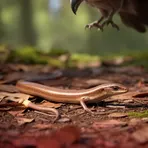
A legless lizard like a snake that sheds and regrows its tail
Surface Forms
Morphology
As a noun–noun compound, 'glass lizard' composes transparently in that 'glass' modifies 'lizard', so a B1 learner who knows both words can infer it names a type of lizard with glass-like properties (e.g., fragile or resembling glass). However, the precise biological traits (legless form and tail that breaks and regenerates) are specific and not fully predictable from the constituents, so the meaning is only partially inferable.
Etymology
Glass lizard may come from the way its tail can break easily, so people compared the tail to glass and named the lizard after that. That's why the name now refers to a legless animal that can 'break off' its tail to 'escape'.