
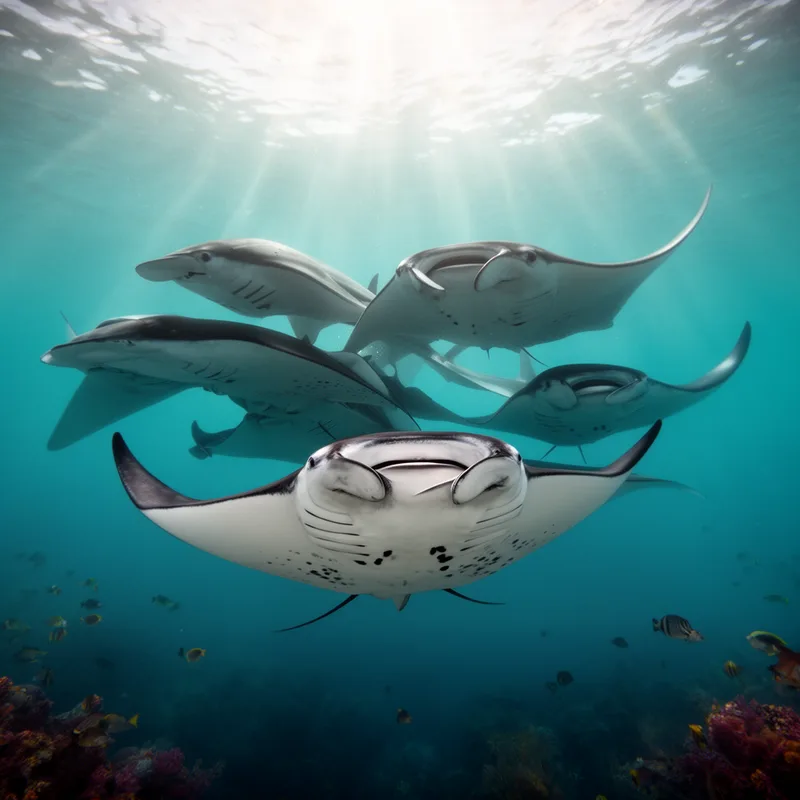
genus Manta
- noun
- /ˈdʒɛnəs ˈmæn.tə/
- Specialized
 :
género Manta
:
género Manta
- The genus Manta includes some of the largest living rays in the ocean.
Examples
-
Scientists have identified several species within the genus Manta based on genetic analysis.
-
The genus Manta includes the largest rays in the ocean.
-
Protection efforts for the genus Manta are increasing due to declining populations.
-
Did you know that the genus Manta has two species?
-
The genus Manta consists of two species known for their enormous size and gentle nature.
-
Researchers study the genus Manta to understand their behavior and migration patterns in tropical waters.
-
Efforts to conserve the genus Manta are essential for maintaining the health of marine ecosystems.
Surface Forms
Morphology
This is directly compositional: 'genus' (a biological rank grouping related species) combined with 'manta' (a giant ray) yields the meaning 'the taxonomic genus that contains manta rays.' The construction follows standard scientific naming patterns that are cross-linguistically transparent, so a B1 learner who knows both words can infer the MWE's meaning.
Etymology
Genus Manta comes from the word Manta, which means 'blanket' in Spanish because the ray's wide, flat body looks like a floating blanket. The word genus is a scientific word for a 'group' of species, so genus Manta means the group of large, blanket-like rays.

