

manta
 5
7.2
5
7.2

- noun
- /ˈmæn.tə/
- Three manta rays swim above us.
- manta ray
Examples
-
A pair of manta rays mating in the turquoise shallows, one on top of the other.
Academic text (1996) -
Flick on your high-powered flashlight and watch as massive, floppy, docile manta rays appear around you, sucking up phytoplankton.
Blog text (3) -
It's just a manta ray.
-
Did you know -that the largest fish in the world is the manta ray?
-
"I saw a manta ray near the point this morning," the colonel said.
Fiction book (2002) -
What do you think about manta rays?
-
Now, in order to find these giant manta rays, we went to all different parts of the Big Island, even some pretty inaccessible places.
-
Scientists have found the largest known population of oceanic manta ray thriving off the coast of Ecuador.
-
Regular visitors also include snappers, sailfish, marlin, manta rays, reef sharks, and an occasional whale shark.
Academic text (1995) -
During our dive, we were amazed to see a giant manta gracefully gliding through the water.
Synonyms
 2
4.8
2
4.8
A very large sea animal with wide triangle-shaped fins that eats tiny sea plants and animals
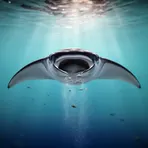
A large sea animal with wide fins like a manta that swims near the surface and eats plankton
Compounds
2
4.8
A very large sea animal with wide triangle-shaped fins that eats tiny sea plants and animals
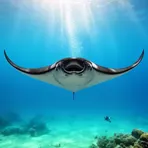
A very large sea animal with a flat body and wide fins that lives in warm Atlantic waters


Surface Forms
Etymology
Manta for the large ray comes from Spanish manta meaning 'blanket' or 'cloak', because the ray's wide fins look like a swimming cloak as it moves through the water.