
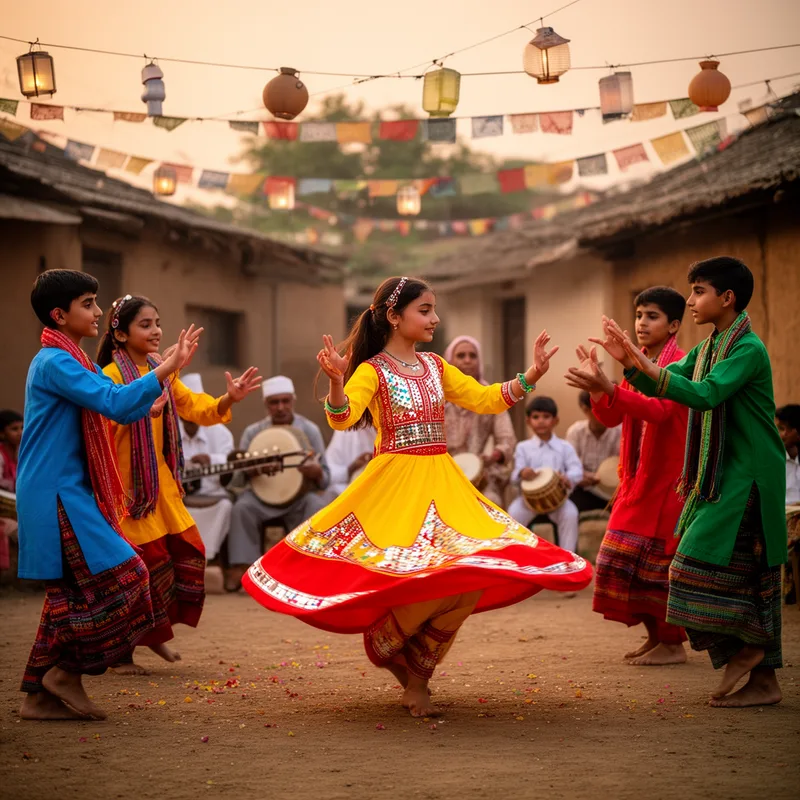
folk dance
 1
2.7
1
2.7

- noun
- /foʊk dæns/
 :
danza folclórica
:
danza folclórica
- Richie stood at the front of the room by the bulletin board that held announcements of upcoming folk dances, poetry readings, and a sign-up sheet for the next outing to Sizzler.
- perform a folk dance
- national folk dances
Examples
-
Opposite the market is Ubud Palace, the venue for Balinese folk dances.
Academic text (2001) -
In addition, the city's Playground Association sponsored a Sane Fourth play festival, at which children from various playgrounds and settlement houses performed folk dances and gave exhibitions of "native games."
Academic text (2000) -
For instance, we play football and basketball, we learn chess, and take folk dance courses.
Academic text (2010) -
In Japanese folk dances, imitation of nature is prevalent, in keeping with their attention to nature in all art forms.
Academic text (1996) -
An open-air piazza awaits you where colorful shows of Italian folk dance and song are performed throughout the day.
Academic text (1995) -
A dramatic highlight of the fiesta is the danza de la pluma, a folk dance that retells the story of the conquest of Mexico.
Academic text (1993) -
Furthermore, educational activities with social content such as chess, folk dance, and drama were arranged, as well as psychosocial and health-related classes such as anger management or avoiding HIV/AIDS.
Academic text (2010) -
Children's Palaces provide after-school and weekend enrichment in ballet, gymnastics, martial arts, oil painting, keyboard, pop bands, folk dance, model making, English, and electronics.
Academic text (1992) -
At the festival, we enjoyed a vibrant performance of folk dance that showcased the region's rich cultural heritage.
-
The community gathered to celebrate their traditions with a lively folk dance under the stars.
Synonyms
 6
6.1
6
6.1
A lively dance from Scotland or Ireland with quick steps
 3
3.2
3
3.2
A country dance for four couples who face each other and follow a caller
 1
2.8
1
2.8
A dance from a community that people learn from their grandparents

 1
7.7
1
7.7
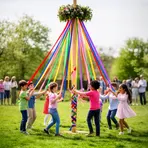
A group dance around a tall pole decorated with ribbons and flowers
 1
3.3
1
3.3
A traditional group dance where couples face each other in lines and do the same steps to folk music

Dances that people in a region pass down over time
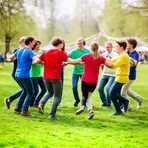
A group of people who form a circle and dance together, often holding hands
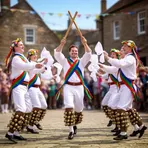
A traditional English group dance with dancers in costumes who use sticks, handkerchiefs, or bells
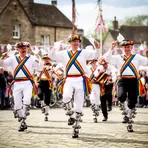
A traditional English group dance with live music and colourful costumes

A traditional folk dance where couples stand in sets or lines and do the same steps to music

A lively folk dance with couples in lines doing set steps
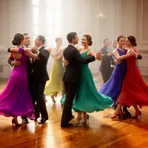
People move together in a circle following set steps, often with partners
How Traditional
1
2.7
 1
3.2
1
3.2
Surface Forms
Morphology
The meaning 'to perform a traditional dance of a community' is directly and transparently built from 'folk' (people/community traditions) + 'dance' (to move rhythmically), so a B1 learner who knows both constituents can infer the MWE meaning. This compositional pattern is cross-linguistically common (e.g., Spanish 'danza folklórica', French 'danse folklorique') and follows ordinary noun+verb semantics, supporting a transparent classification.
Etymology
Folk dance comes from village life, where folk means ordinary people and dance was the simple group movement at festivals and celebrations. Because these dances told local stories and were passed down for years, folk dance now means 'a traditional dance of a community'.