
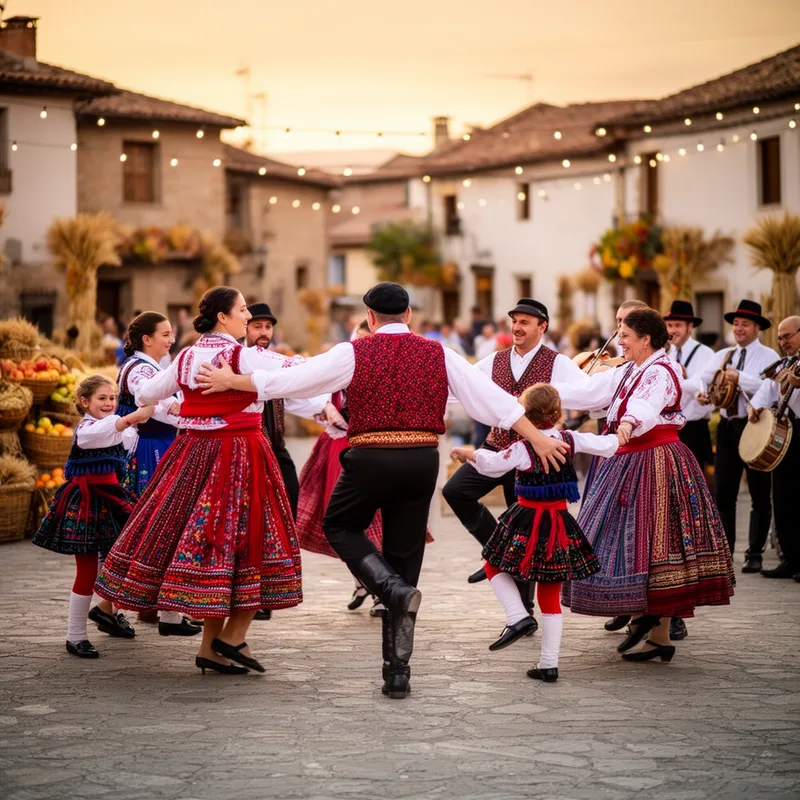
to folk dance
- verb
- Every summer, the village hosts a festival where residents folk dance around the bonfire, celebrating their traditions.
Examples
-
At the community celebration, people gathered to folk dance together, preserving the rich customs of their ancestors.
-
During the cultural event, many children folk danced joyfully, showcasing the unique movements from their heritage.
-
Did this folk dance come all the way from her daddy's world?
-
Porthos and a barmaid get up and begin a festive folk dance.
Fiction book (1993) -
In the nineteenth century, an increasing sense of national identity meant that Russian ballet, while still based on a French movement vocabulary, was strongly influenced by Russian folk dance and music.
Academic text (2000) -
In my personal experience, I have found that "rolling eyes" often turn to smiles, laughs, and genuine pleasure while participating in folk dance: it's the reason these activities have remained part of the music teacher's repertoire.
Academic text (2011) -
It also spawned a series of subsidiary associations, including a folk-dancing society, a genealogical association, and a group dedicated to preserving the local dialect.
Academic text (1995)
Synonyms


 1
4.0
1
4.0
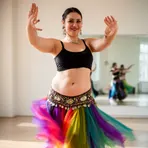
To move the hips and stomach in a Middle Eastern dance

To dance in sets or lines to traditional folk music
How Traditional
 ∞
1.0
∞
1.0
Surface Forms
Morphology
The meaning 'to perform a traditional dance of a community' is directly and transparently built from 'folk' (people/community traditions) + 'dance' (to move rhythmically), so a B1 learner who knows both constituents can infer the MWE meaning. This compositional pattern is cross-linguistically common (e.g., Spanish 'danza folklórica', French 'danse folklorique') and follows ordinary noun+verb semantics, supporting a transparent classification.
Etymology
Folk dance as a verb comes from people in villages gathering to dance together at festivals, with folk meaning ordinary people who shared the steps. So to folk dance means 'to perform a traditional community dance'.