

flying bomb


 1
7.9
1
7.9
- noun
- Archaic
- Their new flying bombs have no pilots.
- V-1 flying bomb
Examples
-
For the flying bombs, they had to have elaborate ramps.
-
In a matter of months, the air force completed Peenemunde's West Works, which included an airfield, hangars, administration buildings, and a catapult to test launch its flying bombs.
Academic text (2002) -
We think they're for a kind of flying bomb.
-
Weary bombers, such as the radio-controlled B-17G Flying Fortress, were used with small success as flying bombs during World War II.
Academic text (2003) -
The 12-foot long, 10-foot wingspan flying bomb was tattered and worn after more than 50 years in storage, yet remarkably, its fuselage, wings, and tail assembly were still intact.
Academic text (2001) -
The military deployed new flying bombs to enhance their attack capabilities.
-
Engineers worked tirelessly to improve the design of the flying bombs for better accuracy.
-
During World War II, the German forces used the flying bomb to target cities from the air.
Synonyms
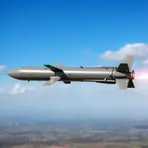 55
6.3
55
6.3
A flying, unmanned weapon that carries a bomb to a distant target with high accuracy
 1
9.9
1
9.9
A German flying bomb used in World War II to attack cities
 1
9.4
1
9.4
A small jet-powered flying bomb used by Germany in World War II to attack cities

A small jet-powered flying bomb used by Germany in World War Two
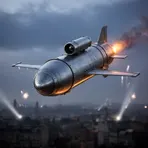
A missile with wings and a jet engine that carries explosives to a target without a person on board
Surface Forms
Morphology
The phrase is a straightforward modifier+noun composition: 'flying' describes something that flies and 'bomb' is an explosive device, so a B1 learner who knows both constituents can infer it denotes a bomb that flies (an airborne/jet-propelled missile). While technical specifics (e.g., wings, jet propulsion) are specialized, the core meaning is directly derivable and follows cross-linguistically common patterns.
Etymology
Flying bomb was a name used in World War II for weapons like the V-1. These were small bombs with an engine and wings that really flew to their target, so the name shows a 'bomb that flies' and today means 'a small weapon with wings that carries an explosive'.