
fieldwork
- noun
- /ˈfiːldˌwɜrk/
- Archaic
- The fieldwork was conducted primarily at Fort Stewart, Georgia, and Fort Drum, New York, between May 1998 and September 1999.
Examples
-
Caudell listened to them scrabbling over the lower fieldworks there; they disappeared from sight until they came back out onto the Brock Road.
Fiction book (1992) -
The fieldwork was uneventful, but the easement never came to fruition.
Academic text (2001) -
Western archaeologists first used fieldwork as a front for spying during World War I. T. E. Lawrence's excavations with British archaeologist Leonard Woolley at the Syrian site of Carchemish mixed archaeology and surveillance.
Academic text (2003) -
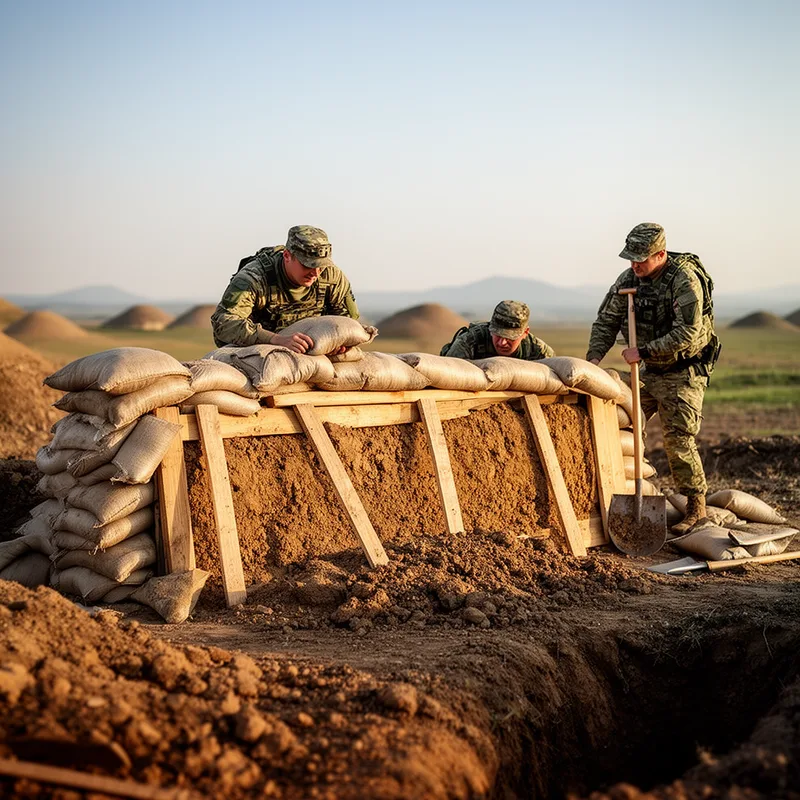
During the military operation, the troops constructed a temporary fieldwork to shield themselves from enemy attacks.
-
The soldiers quickly built a fieldwork near the frontline to enhance their defensive position.
-
After surveying the area, they decided to create a fieldwork to protect their supplies from potential threats.
Synonyms

 9
6.6
9
6.6

A wall or earth mound built to protect a place from attack
 1
9.3
1
9.3
A low wall of earth or wood about chest high that soldiers build to protect themselves
A defensive position where soldiers stand behind trenches during war

A defensive structure outside a fort that gives extra protection
Surface Forms
Etymology
Fieldwork comes from the two simple words field 'open land' and work 'something made or done', and it was used for the temporary walls, ditches, or small forts soldiers built out in the open during battle. That's why a military fieldwork is a quick defence made in the field.