
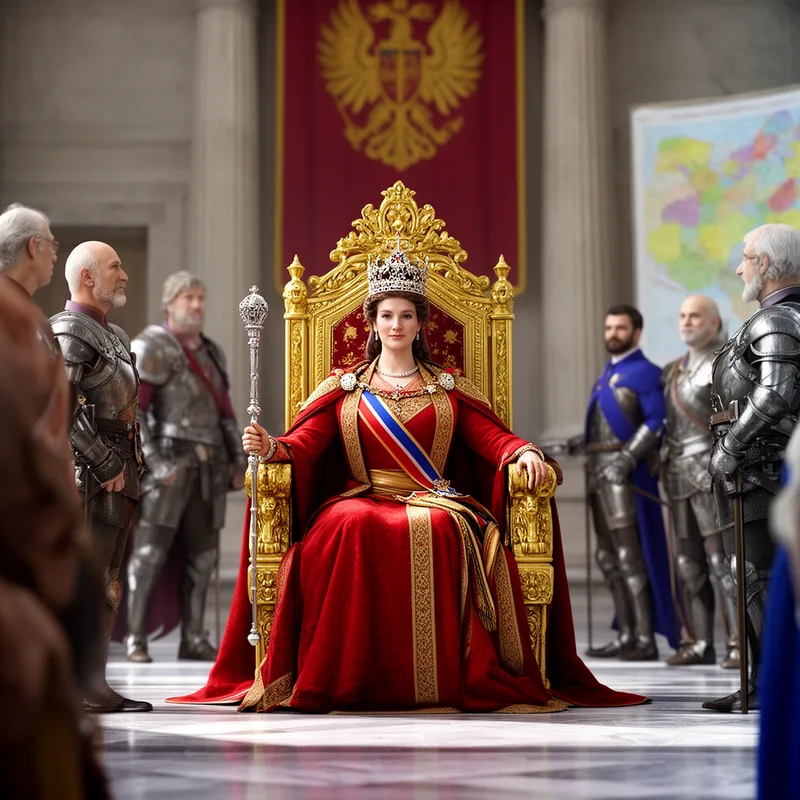
female monarch


 1
5.4
1
5.4
- noun
- /ˈfiːmeɪl ˈmɒnərk/
- Many stories and legends surround female monarchs throughout history, highlighting their challenges and triumphs.
Examples
-
Such a perception of a queen, of course, was not unknown in early modern Europe: as the case of England's Elizabeth I demonstrates, a female monarch's status as sovereign could thus, under certain circumstances, supersede her status as a woman and even constitute her to some extent as masculine.
Academic text (2001) -
Queen Elizabeth II was a female monarch who ruled the United Kingdom for over 70 years.
-
During her reign, the female monarch implemented several significant changes in the country's laws.
Synonyms
 549
1.0
549
1.0
A woman who rules a country or is the king's wife
 153
2.1
153
2.1
A person who has power over a country or its people
 72
5.0
72
5.0
A woman who rules an empire or who is married to an emperor
 41
5.1
41
5.1
A king or queen who rules a country and usually gets the job by birth
 40
7.2
40
7.2
A king or queen who rules a country and gets the position from their family
 1
7.8
1
7.8
A king or queen who rules because they get the position from their family
 1
9.9
1
9.9
A king or queen with complete power over a country

A woman who rules a country because she inherited the throne

A short respectful name for the queen of the United Kingdom
Antonyms

How Powerful

Surface Forms
Morphology
The meaning is directly and compositionally derived from 'female' (a woman) + 'monarch' (a sovereign ruler), so a learner who knows both words can infer 'a woman who reigns'. This adjective+noun composition is cross-linguistically common and follows standard English patterns, making it immediately comprehensible to a B1 learner.
Etymology
Female monarch is a literal name: female means a woman and monarch comes from words meaning 'one ruler', so it pictures a woman who is the single ruler of a country, which is why it means 'a woman who rules'.