
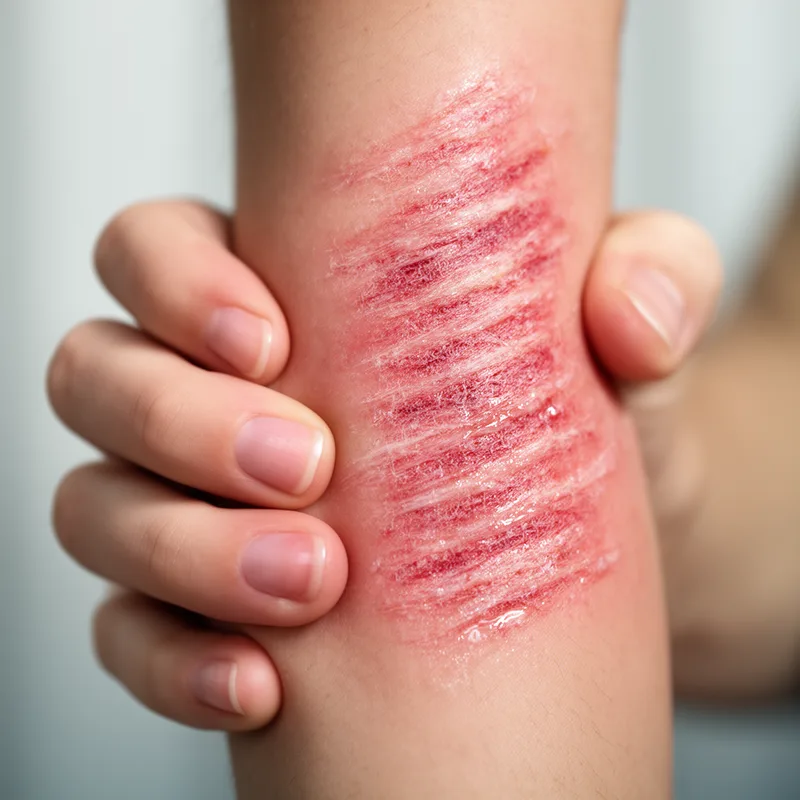
to excoriate
- verb
- /ɪkˈskɔːriˌeɪt/
- Specialized
- I believe the excoriated skin contains a great deal of fungi, usually Candida albicans, Aspergillus niger, or Aspergillus flavus.
Examples
-
Shortly before dawn this morning... security staff at London Zoo discovered the excoriated carcass... of its prized three-year-old female Siberian tiger, Sue Ling.
-
She makes a delicious meal from it, but when she discovers the source of the rosemary, she almost vomits, excoriating her son and throwing the food away.
Academic text (2007) -
It is a cancer that must be excoriated.
Blog text (20) -
If the skin of the patient's neck is excoriated, culture will almost always identify Candida spp.
Academic text (2003) -
She wounds and excoriates the lips that approach her, continues Lamb, regarding the pineapple.
Fiction book (2001) -
Numerous ulcerated and excoriated nodules are seen adjacent to the nares.
Academic text (1998) -
The helical cartilage and pinna of the right ear are inflamed and thickened, and the overlying skin is erythematous and excoriated.
Academic text (2003) -
The patient complained that his skin became excoriated after wearing the tight bandage for too long.
-
The child accidentally excoriated his knee when he fell off his bike.
-
Constant scratching can lead to excoriated skin, which may become infected.
Synonyms

 5
5.6
5
5.6

To make skin sore by rubbing

To wear away the skin by rubbing

Removes the top layer of skin or material by rubbing with something rough
Antonyms

How Severe

Surface Forms
Morphology
excoriate = ex + cori + ate
The components (ex- 'out' + -ate) signal a removal action, but the central combining form 'cori' (skin) is not a standalone English word, so learners may only partially infer the literal sense.
Etymology
Excoriate comes from the Latin parts ex- 'out' and corium 'skin', so it originally meant 'to take the skin off'. That's why today excoriate can mean to damage or scrape the skin.